• Skip to primary navigation
  • Skip to main content
  • Home

Lucid Content. Writing for Humans.

Lucid Content

Website Copywriting

The low spark of low-heeled boys

April 15, 2018 by Richard

[dropcap]I[/dropcap] woke up in the Emergency Room. St. Anne’s Hospital. Where I was born. My mother and my sister were in the room. I still remember the nurse. “Is he a user?” I’d passed out and fell backward onto the sidewalk and hit my head full on. As I lay there, writhing and convulsing, my girlfriend called an ambulance.

I had a bit of a secret. Poorly kept. The situation was delicate, touch and go. I conjure up an image of my teenage self sprawled out on a lawn, at some outdoor concert, half conscious. Don’t know what this bird flew into, but shit don’t look good. The world was spinning faster and faster. Try and keep up. High-school in New England. A mean, beat down, beaten up, mill town south of Boston. Cramped tenements. Chain link fences. Small bore gangs of Irish, Poles, Portuguese. A lost American city. Lost American boys.

Croke was tall, lanky, dispirited. A lad in a brown leather jacket and jeans, with shoulder length, dirty blond hair. I can’t remember Croke being much of a threat to anyone but himself. Croke loomed large at school and on the street. Mainly because he had a monster heroin habit. More than once, I saw Croke being dragged down the hall, his arms around the shoulders of two burly teachers, his feet dragging behind him. Eyes rolling around in his head. They struggled to get him out of the building, down the stairs and stuffed into a cab. Next day they would do it all again.

Dope was easy to get. Like buying a bag of chips. Like whistling at a pretty girl. Dope was language. Fuck you, it said. The men’s bathroom in high-school was part of the franchise. Mom’s sandwich baggies filled with Tuinal, Seconal, Quaaludes, heroin, speed. The cost was low — lunch money low. You could get anything you wanted at Tadeusz Kosciuszko Square five minutes from my house. The Square. At the Square, you could buy your way into your own imprisonment beneath a statue of a Polish hero of the War of Independence. The irony was lost on us. We weren’t interested in independence. Ours was a more noble conflict — obliterate the self. That stealth army spreading a miracle of warmth across your tender groin, courtesy of Adolph von Baeyer, inventor of the barbituate. Just take me out, Adolph. Across from the Square was Joe Gow’s, where you could get a greasy chow mein sandwich in wax paper and a coke for two-fifty, when you resurfaced and got hungry.

Killer Cabral. I don’t know if Killer had killed anyone when I knew him, but the chances are good, or got around to it in due time. I have one memory of Killer. I’ve got my mother’s car for the night. I’m seventeen. Killer is in the back seat — this is an eight-cylinder Oldsmobile Cutlass, maroon. A machine. I’ve disconnected the odometer. Killer is small. In a black leather jacket. His street rep is fearsome. Killer Cabral is in my car. He’s cooking junk in a spoon. He’s got his works out. Rolls up a sleeve. Ties off, finds a vein. Pushes the needle in. Tilts his head back for a second, eyes closing… Come to daddy.…that’s it. Then, Killer is out. Into the night. Hey, Killer Cabral was in my car last night. No way. Way.

For a while, my best friend was Fat Larsch. Toothpick thin. Stringy blond hair. We were tight for three years. Concerts, camping, ski trips, open-faced turkey sandwiches and mashed potatoes at the counter at Rockland Diner. Quarts of Bud. All the shit that kids do. Add weed, downers, and the occasional speed. I never once set foot inside his house. Some kind of weird trouble was going down in that darkened third-floor apartment. Finally, Fat Larsch went for the needle. He died of an overdose. By then, he’d become a respiratory technician at the local hospital. St. Anne’s. I never went to the funeral. I never went for the needle. That was a line I wouldn’t cross.

I woke up in the Emergency Room. Tied it off. All the people who were part of the old world, over. I passed them on the street. I did not meet their eyes. I did not speak. No hellos, no how you doing. I don’t see you.

{ photograph by richard pelletier }

This low-heeled boy had a dream — a wanting. It was so bonkers, so outlandish, and freakish, and buried so deep, it would take over four decades to dig it out. Wanted that mother so hard, had to wrap that fragile thing in blankets and shame and lies and foolish loves and silence.

Touch and go.
Filed Under: Branding, Copywriter Portfolio, Freelance Copywriter, How to Write Better, Online Copywriter, Seattle Freelance Copywriter, Storytelling, Taking Risks, Website Copywriting

May 31, 2017 by Richard

Dear writer, copywriter, branding person, corporate communications professional, poet, storyteller, word lover

World-famous, there’s-nothing-else-like-it-anywhere Dark Angels writing workshop lands on east coast of America in 2017

[dropcap]H[/dropcap]ow goes it? Is your writing everything you want it to be? Could you do with a shot of inspiration? A double shot of joie de vivre? A triple shot of ‘I never knew I could write like that?’ Is there a wee bit of room for improvement? For a potentially life-changing experience?

I want to introduce you to some of the work I do and the people I do it with. I’m reaching your way for a couple of reasons. You’re a good writer. You’re interested in words and stories. For you, business, life, and art are not all that far apart. No silos. And, you like to connect. Which means you are, ahem, the target audience.

first, the back story…

A few years ago, I went on a few writing workshops. The first was in Spain, outside of Seville. The next one was at Oxford. During which we had dinner with Philip Pullman. So, these weren’t just any writing workshops. These were Dark Angels workshops. Twelve years in, over 300 people have rolled through the Angelic writing machine. People talked. So I went on this workshop, they’d say. And they’d get all glassy eyed. The thing was a phenomenon.

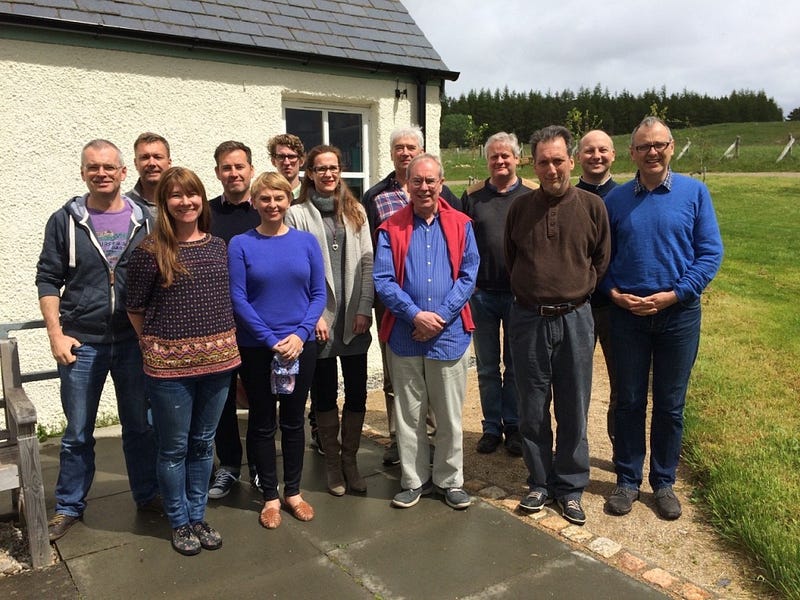
Then, in 2015, I was invited to join the firm, as it were, as a tutor. Or, as we are officially known, Associate Partner. The three original founders of the company, John Simmons, Stuart Delves, Jamie Jauncey, felt the need for reinforcements. So nine additional writers, including yours truly, were, you know, onboarded. We are now 12. (Being asked to join that crew was sweet. I cried.) Here we all are at Scotland’s Creative Writing Centre.

Back row L to R: Mike Gogan, Andy Milligan, Neil Baker, (Jamie Delves along as filmmaker) Jamie Jauncey, Stuart Delves, Mark Watkins — Front row L to R; Elen Lewis, Gillian Colhoun, Claire Bodanis, John Simmons, Richard Pelletier, Martin Lee

The tagline for Dark Angels is Creative Writing in Business. We run our workshops in Spain, England, Ireland, Scotland, possibly New Zealand and this year, the US. Our focus is on business writing, although all kinds of writers have come. Our ship has three captains: London-based novelist and copywriter John Simmons; Edinburgh-based copywriter, poet and playwright, Stuart Delves; and copywriter, musician, and novelist Jamie Jauncey. You will not find three kinder, more talented writer-humans if you tried.

We stand for the power of words and writing, and for personal connection, kindness and fellowship.

When you hear the concept of ‘brand voice’ or ‘tone of voice’ in marketing communications, that’s John Simmons idea. (Many people are saying that the notion of voice in business writing was in the air in the 90s and Alan Siegel of Siegel + Gale also came up with voice as a concept at around the same time. We accept this version of history.)

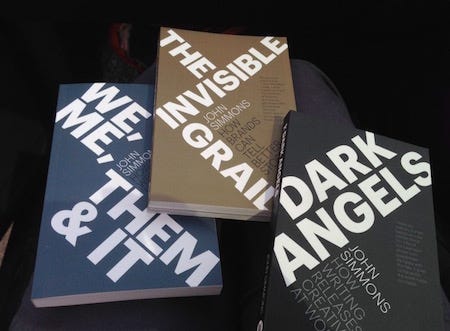
I discovered John’s books in 2006 and got very excited. Long story short — I got to know him, became a friend of his and his family, have stayed with him in London, and now I’m part of the company. He and his family are lovely and brilliant people.

The whole Dark Angels thing is virtually unknown in America. (Hence, this.) At least I think it is. As far as I can tell, I’m quite possibly the only American who has been to a DA workshop in those 12 years.

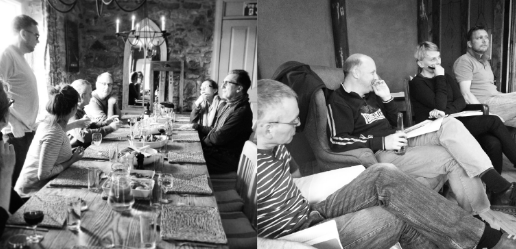
The workshops usually are residential affairs between three and four or five nights. (We’ve recently added a Taster Day option.) We spend a lot of time writing. We have our recipe book filled with writing exercises — sonnets and six-word stories and all kinds of fascinating, challenging and imaginative ways of wrestling with story, with words, with language, with writing. Ours is not a ‘how to’ kind of workshop. It’s more a matter of creating a safe, intelligent space to fucking write. We help guide writers as they strike out into different territory. And this is truly different for a writer’s workshop: no critiques. We’ll offer some thoughts about the value of what we’ve asked you to do and we’ll ask you to tell us about it. A simple ‘how was it, trying to write that sonnet, tell us about it.’

The combination of our writing exercises, some collaborations, our conversations about books, writing, music, art, our dinners together, our wine, etc. — the whole wonderful smorgasbord of writers talking, thinking things out and writing, has a powerful effect on people who attend. Folks find new confidence; they get emotional, they get reinvigorated. They find their voice. Imaginations get stoked and stimulated. Lots of people have said the experience changed their lives. I’m one.

The curious and interesting thing is how we tie our creative writing exercises back to business. There are real pearls of wisdom to take back to work.

So Dark Angels is going to come to America this year in early October. We’ll be in Dartmouth, MA, right next to New Bedford in Melville territory. We’ll be in this house in the photo below. John Simmons and I are running this one together. Reader, it is catered.

Dartmouth, Mass: The site of Dark Angels America 2017

So I’d like to invite you to come. Or, if you think someone on your team at HubSpot, or MarketingSherpa, or Slack, or WebMD could benefit from an immersion experience that will likely excite them and boost their confidence in their writing…We’re aiming for 6–9 people. But no more than 10 I don’t think.

Many Dark Angels writers are freelancers. Many are in-house writers from places like —

Arts Council of Wales, Bang & Olufsen, Barclays, The BBC, BP, British Airways, Carlsberg Breweries, Clore Leadership Programme, Corporate Culture, Elmwood, The Environment Council, Granada Media, Innocent, Interbrand, Lever Faberge, Mazars, National Library of Wales, O2, Penguin Books, QI, Royal Society of Arts, Scottish Arts Council, Sotheby’s Europe, Swiss Reinsurance, Three.

The crew in Scotland…

Thanks for reading. If you’d like to know more, visit the website.

https://lucidcontent.com/2017/05/31/dear-writer-copywriter-branding-person-corporate-communications-professional-poet-storyteller-word-lover/

Filed Under: Branding, Freelance Copywriter, Inspiration, Online Copywriter, Website Copywriting, Website Copywriting, Portland, OR, Writing Tips

Your Website Considered

September 2, 2010 by Richard Leave a Comment

Your Website: First Chance to Make a Lasting Impression

As a business owner, or marketer, you are intimately concerned with the decisions that other people make. Your principal goal is to affect those decisions and to persuade people to choose you over the other guys. As you might expect, there is both art and science involved in the art of persuasion.
In today’s column, I’ll discuss a few ideas that might help you think differently about how your home page, and your website in general can help or hinder these decisions.

Take a Customer-Focused Approach
The words you use on your website communicate to the visitor what your focus is. If your home page blasts a 72-point headline that says, “We’re the Number One Interior Design Firm in the Northeast,” then it is very clear where your focus is. It’s on yourself and your amazing number oneness.

In this instance, you are “marketing” to people, which means you are not having a conversation with them. And all marketing is conversation, especially these days. And not to put too fine a point on it, but who cares if you are No. 1? In certain marketing circles, this is referred to as the dinner party problem. Who would you rather meet at a dinner party? The person who can only talk about himself? Mr. “I’m Numero Uno?” Or, the person who is genuinely interested and curious about you?

A customer focused approach means that the aim and thrust of your site is less about how great you are and more about helping your customer/visitor easily learn, do, achieve what they set out to learn, do or achieve. Minus the chest thumping.

Language and the Gobbledygook Manifesto
A customer-focused approach goes a little deeper than what I’ve outlined above. A customer-focused approach avoids what David Meerman Scott calls, “gobbledygook.” In the Gobbledygook Manifesto, Scott identifies meaningless phrases like cutting-edge, market leading or my personal favorite, solutions.

Scott has said gobbledygook is a problem because these words have lost their meaning. He’s right about that.

But I think it’s more than that. Gobbledygook is a problem because it leads with your language and your point of view instead of your customer’s language and point of view. This kind of language puts a wall up between you and your visitor.

Here’s an example.

Let’s say you and I meet at a dinner party. I ask you what you do for a living. You look me right in the eye and say, “Bay state interior design is a leading provider of interior design solutions for residential, business and government environments.” I would look for another drink. Wouldn’t you?

But what if you said, “Thanks for asking. Our company does interior design. We focus on sustainable materials and ergonomically correct workspaces. We’ve got quite a few residential clients, quite a few in business and government, too. We’re all about helping people create comfortable and productive workspaces.”

A Marketing Voice versus A Human Voice
That first voice is a deadly marketing voice and, sad to say, it is all over the Internet. The second is a human voice, and a human voice is the one that connects. It’s that voice, true and authentic, that signals a customer-focused mindset. It is that voice you need to get onto your website.

P.S.
Gerry McGovern is a highly sought after web content specialist based in the UK. He’s written a new book, The Stranger’s Long Neck that outlines his views on how people use websites. Mr. McGovern also puts out a weekly newsletter that I highly recommend for anyone who has responsibility for an organization website. Just click his name to get to the subscription page.

Next week: Cognitive Fluency. What it is and why it matters.

Filed Under: Copywriting Firm, Portland, OR, Freelance Copywriter, Oregon Copywriter, Web Content Writer, Portland, OR, Website Copywriting, Website Copywriting, Portland, OR Tagged With: home page, marketing voice, website

Murder Your Darlings, or Robert Frank’s Big Editing Adventure

October 4, 2009 by Richard Leave a Comment

Professional Writer - The Americans
Robert Frank’s ~ The Americans

Once upon a time in a long-forgotten place, I fell in love. This was a life-changing, head-over-heels-kind-of-love, and the subject of my swoon was Robert Frank’s seminal book of black and white photographs, The Americans.

At the time, I was an aspiring photographer, and Frank’s pictures blew the top off my head and showed me what photography could be. The Americans had the same effect on tens of thousands of other photographers at all skill levels, and it reverberated among artists, writers and other observers of the American scene. Such is its power that 50 years later we are still talking about and showing the Americans.

Frank’s pictures were idiosyncratic, brutally honest, dark, foreboding and furtive. Those pictures absolutely killed. Robert Frank’s take on America was almost exactly the opposite of the country’s prevailing vision of itself – more Allen Ginsberg and Jack Kerouac than Eisenhower. It was a beat generation document but a whole lot more. The Americans upset a lot of people of course, given the less than rose colored tint it portrayed. “A sad poem for sick people” was one comment.

In the recent New Yorker write-up on the Frank show at the Met, Anthony Lane remarks on how Frank shot over 760 rolls of film on three trips around the U.S. on a Guggenheim grant. He developed his film, made his contact sheets, and set about printing a group of selected images. He printed one thousand work prints (a work print refers to a quickly made image that a photographer will consider over time and then later print to exacting specifications) of this place called America. That a Swiss born Jew in 1955 would conceive of somehow capturing the soul of these United States in a group of photographs is quite an astonishing proposition, but that’s a discussion for another time.

Here is what’s amazing. Robert Frank shot thousands upon thousands of photographs – 27,000+ in all. It’s not unusual for a documentary, street-shooting, photo-journalist type of photographer to shoot vast amounts of film – it’s the nature of the beast.

What’s incredible is the discipline and vision it took for Robert Frank to cull through his work and edit it down to only 83 (!) pictures. In the shooting, he collected the raw data. But like the filmmaker that he would soon become, it was in the editing room where the miracle occurred.

Through careful (and brutal) editing, and his sequencing, he told his unique story, changed the course of contemporary photography, influenced legions of photographers who followed him, and, reflected back to us an image of ourselves wholly unexpected, uncomfortable, unsettling, true.

So any of us who write for a living, (or do other kinds of creative work) one of the lessons of Frank’s achievement is this: Great work involves culling, murdering your darlings – letting go of all your favorite, nifty little phrases and word choices and give the reader the heart and soul of the story.

Murder your darlings, if you have not yet heard the phrase, is attributed to Sir Arthur Quiller-Couch who taught writing at Oxford.

If you enjoyed this post, please consider sharing it with every person you have ever met. Comments are welcome and commenter persons are automatically entered into a drawing for a super big prize.

Filed Under: Freelance Copywriter, Online Copywriter, Website Copywriting

“If You Want to Work Here, Close!!”

August 21, 2009 by Richard Leave a Comment

Put That Coffee Down! Coffee is for Closers Only
Put that coffee down! Coffee is for closers only.

By now, I hope and pray that you have all seen and worship one of the greatest American movies of all time, Glenn Gary Glen Ross. Alec Baldwin’s now famous tongue lashing monologue has been seen a gazillion times for good reason — it’s absolutely brilliant. On the wild chance you haven’t heard, this is the film that made the phrase, “coffee is for closers” famous. At one point in his tirade, Baldwin bellows, “Put the coffee down. Coffee is for closers only.” And later on, “If you want to work here, close!!”

Baldwin’s “always be closing/coffee is for closers” mantra came to mind recently in my own business. I didn’t close. So no coffee for me.

Here’s what happened. I met with this fellow, nice guy, small business owner. He felt trapped in his business. He’d prefer to sell, but no one is buying. He reached out to me because a mutual friend/acquaintance told him I could do a bunch of cool internet marketing stuff for him. Which is true, I could.

So he called and we had coffee and had a great chat. I left that coffee believing I had a new client. Then I sent him a proposal. “Gulp” was a word he used when he saw the numbers. He then asked me if I’d be interested in a trade – he provides a very cool service – so I said “yes” without hesitating. Then he bailed out on me entirely.

I don’t know the full reason why he bailed, but part of the reason is he thought I was nuts he didn’t understand the strikethrough tool and thought I was hanging out my dirty editing process for the world to see. There’s a bit more to the story that prudence leads me to leave out. But I’ve taken the position that I didn’t make clear enough what value I could deliver. Major fail on my part. I had an opportunity to close, and didn’t. So here’s what I say to all prospective clients.

I will help you think more clearly about your business and will help you position yourself with regard to your competition. I will ask you many penetrating questions to get to heart of your core value.

I will research the competitive landscape.

I will help you develop a unique value proposition.

I will interview your customers to hear what they have to say.

I will write clever, benefit laden headlines and great emails.

I will stick with you for months as we work together on a large ebook project – and I will interview people all over the world.

I will stay up all night to help you win that new project.

I love the written word, and live for the clear organization of complex material.

I know and work with good designers – people who can help clarify and communicate your company’s value proposition and your reason for being.

I am easy to work with and comport myself as a professional.

I will help you understand how SEO works and I can help you achieve rankings in Google search queries.

I will work with you until you are happy with what we’ve done.

I will tell you if I’m not the right person for your project.

I won’t surprise you with a fee that you weren’t expecting.

I will have suggestions for you that may surprise you.

I will deliver more than you expected.

Let me repeat: I will help you close.

Filed Under: Website Copywriting

The Wine of Redemption ~ Paris and Google

June 28, 2009 by Richard 2 Comments

Library of Congress Public Domain Image of the Eiffel Tower
Eiffel Tower Public Domain Image

In my last post, I talked about how Facebook and Google have different – and competing – visions of the web. Google is all about data. They scoop up as much data as they can in order to drive the most relevant search findings to your desktop. As you may have noticed, they are kind of successful at this.  Facebook is no slouch when it comes to data, but they envision a “humanized web” where friends, peers, colleagues and family members deliver answers and recommendations to such everyday questions as “How do I redeem myself for recently forgetting my sister’s (very important milestone) birthday, and buy her a bottle of great French champagne during her visit to Paris?”

Putting the Question to The Google

Where to begin? Yes, I did go out to my network, but not Facebook this time. I simply asked my friend and colleague Jeff Schraeder of Baltimore (he travels to Paris several times a year) if he had any suggestions. Jeff was on the road and tried to help, but his connections were sketchy and I didn’t have too much time. So I went onto the Google and typed, “Wine Shop, Paris”. And up came Chowhound with the following post: “I’ve heard good things about La Derniere Goutte at 6 rue de Bourbon le Chateau in the 6th. It’s owned by an American selling French wines to the French! They do tastings.”

Patty the awesome at La Derniere Goutte.
Patty Lurie at La Derniere Goutte.

La Derniere Goutte

I opened up Skype, called the wine shop and next thing I knew I was talking to Patty Lurie. “I’d recommend the (follow the link for amazing story) Jacques Sellose,” said she, to which I said, “done deal.” I read out my American Express number. I then sent a text to my sister. “Call Patty at La Derniere Goutte, it’s a wine shop. She has something for you.” A day later, there stood Patty being photographed by my very happy sister via her iPhone. (“Patty is awesome. Wish we met her at the beginning!” said one text message.)

When I woke up this morning, I reached for my BlackBerry. I had about six text messages from my sister along with pictures. There they all were, on a sun splashed Paris day, sipping a perfectly chilled champagne. “Thank you, thank you. This was very special.”

All thanks to Google, Skype, the iPhone and Patty Lurie. We have our networks – online and offline – we have Facebook and Google and Twitter and whatever else is coming next. And then there is family. New technologies have their advocates and their detractors, and each side has their own case to make, but it’s hard to argue with tools that let you deliver a special moment to someone you love who happens to be two continents away and to do it in under 5 minutes.

The Wine of Redemption

Patty’s number at the wine shop is 01 43 29 11 62 ; the address is La Derniere 6 Bourbon le Chateau 75006 Paris.

Happy belated birthday, sister.

Filed Under: Website Copywriting