• Skip to primary navigation
  • Skip to main content
  • Home

Lucid Content. Writing for Humans.

Lucid Content

Business Communications

Where are you going with your writing?

April 9, 2019 by Richard Leave a Comment

The Olympic Peninsula (c) Richard Pelletier

[dropcap]T[/dropcap]ell me, where are you headed in your writing life? If you had wings, where would you fly to next? Are you satisfied? You ever think you could kick this thing up a notch or two? Where could you go with your writing if you could make it better by this much? Or that much? What might happen if you knew how a Shakespearean sonnet is made? What if you actually wrote one? And what if you began to fall head over heels with the whole heaving apparatus that is the English language? What would that be like?

Some of us have to write. Some of us want to write. The road that connects us is the sheer difficulty of the journey. Writing is bloody hard. But it’s not impossible to write well, or even beautifully. You just have to commit. And you have to read.

It also helps to find fellow travelers who have walked some of the trade routes and have come back with the spices and the silks, the sonnets and the similes.

So I’ve come here today to talk about the idea of writing as a deep, professional, creative, and spiritual pursuit. A beautiful, sacred undertaking that asks of you everything you’ve got and then asks for more. The pursuit of writing well gives life depth and meaning and a richness that is transcendent. It is fucking glorious to chase this mother down. There is nothing else like it. It is the hardest damn art form there is and it is better than cannabis or bourbon or chocolate. It is the closest thing to jazz.

In love there are two things — bodies and words. ~ Joyce Carol Oates

I remember seeing Joseph Campbell in an interview with Bill Moyers once. The conversation meandered and Moyers said something about people wanting to know the meaning of life. And Campbell said no, he didn’t think that’s what people were after. He thought people were after an experience of life. Meaning was not the holy grail, experience was. I remember thinking this felt exactly right.

And so I want to tell you to seek experiences. Find ways to gather with other humans in the pursuit of writing beautifully. Ask yourself this question. What could possibly be more fun, more inspiring, more, I don’t know… fuckingdelicious, than meeting a bunch of strangers — all engaged in the dogged pursuit of writing well — and spending three or four days together writing and talking and writing and talking and writing? What if you were doing all this in a beautiful place? What could that do to your writing life? Maybe change it forever? It happened to me. And it’s happened to about 300 other writers, too. Published poets, screenwriters, corporate communications people, speechwriters, content marketers, novelists, copywriters. Writers of every stripe.

I speak of the magical, the wondrous, the steeped-in-kindness-and-fellowship-and-personal-connection Dark Angels writing workshops. There is nothing like it anywhere. It is the eighth wonder of the world. Now in our 15th year, the (UK based) Dark Angels operation has flown to New Zealand and to America. If I could clamber up to the top of the world’s tallest building and shout this story out, I would do it.

Good writing isn’t a science. It’s an art, and the horizon is infinite. You can always get better. ~ David Foster Wallace

In Seattle, this June, Dark Angels will run a writing workshop aboard a 65′ yacht. The De Anza III. Our captain and speaker, is a Dark Angels alumnus, Ted Leonhardt. Ted is a brilliant and provocative thinker, and a powerful creative force. He came to a workshop, did some great work and got his wings. He is a hell of a writer and evangelist.

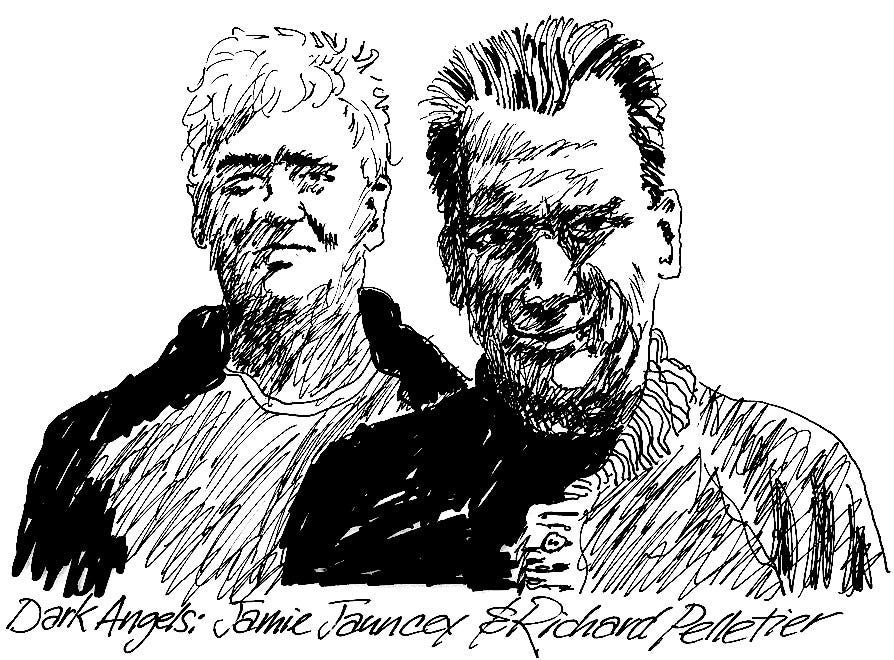
I have the distinct privilege of running this American Foundation course with a hugely talented and big-hearted writer, Jamie Jauncey. Jamie and I ran a Dark Angels America workshop last year. We want you to join us this June on the waterways of Seattle. It promises to be amazing in so many ways.
Great writers are indecent people. They live unfairly, saving the best part for paper. Good human beings save the world so that bastards like me can keep creating, become immortal. If you read this after I am dead it means I made it. ~ Charles Bukowski

I know of a great winged creature named Proust. Proust is normally found near my house, aloft on the southerly winds of Puget Sound making great big loops over Orr Road. Proust has been here forever, inspiring the artists who live on Whidbey. Lately, for reasons we suspect, but will never know for sure, Proust is often seen leaving Whidbey Island and heading out over the water to make a sweeping right turn where the mainland meets the water. Proust heads south and once she’s arrived over Ballard, Proust circles and circles and circles. We think this is because Proust knows in this place, soon, a group of storytellers will gather and she wants to be there. For you. Do not let Proust down.

~~~~~~~~~~~~~~~~~~~~~~~~~~~~~~~~~~~~~~~~

“Attending a Dark Angels course was the single best thing I did for my career, and myself, last year. As I’ve changed roles and companies, one thing was constant — writing. I’m happiest in a role with lots of writing or communicating or editing and I put a high bar on business writing that sounds human and has a personality. And sometimes in business writing, you can lose sight of that human tone among all of the requests to write about fiscal goals and org changes and new processes. So, when I heard about the Dark Angels — a group of professional writers who stand for the power of words and writing, and for personal connection, kindness and fellowship — I couldn’t register fast enough. The candid tutors put me through my paces with thoughtful exercises that taught me if there’s no tears in the writer, there’s no tears in the reader. You don’t have to be a published writer to attend; you just have to be a human who wants to write good words that make people feel your message.”

Lacy Rohre — Director, Content and Communications | EA Customer Experience

“If you want to know how to use a semicolon correctly, or learn the difference between “who” and “whom”, Dark Angels is not the course for you. These are answers found easily inside a book. Instead, Dark Angels is an experience that gently coaxes you into finding something much more important inside yourself. You’ll unearth a genuine, deeply human voice that transforms the way you write everything. I’m sneaking up on 30 years as a professional writer and I astonished myself with some of the sentences that spilled from me over the course of the four days. I feel very privileged to have become part of the chorus.”

Mat Gorbutt, Senior Writer | Fenton Stevens

“Dark Angels was a life-changer. I’ve been an uneasy writer most of my adult life — not trusting my abilities to put on paper what I had in my mind. Dark Angels reminded me about the power of honesty and empathy. Since the course, as long as I feel that I am approaching my writing with those two qualities, I feel much more confident and free of doubt. Thank you for creating a course that spoke to me so beautifully.”

Lourdes Canizares-Bidwa, Associate Director — Marketing | EY LLP


Filed Under: Branding, Branding Work, Business Communications, Business Writing, Freelance Copywriter, Seattle Freelance Copywriter

Blogging Storynomics 9 | Three-act structure and the business of storytelling

June 13, 2018 by Richard Leave a Comment

Wheat Field with Cypresses, Vincent Van Gogh
THREE-ACT STRUCTURE

[dropcap]O[/dropcap]ne of the more curious bits about the intense interest in storytelling for business, is that the two most learned writers in the realm of dramatic storytelling, Robert McKee in America, and John Yorke in England, are taking on business storytelling. Both have quite a lot to offer. Both have deep expertise and experience in the real world of drama, including television and cinema. I took a Story for Business course with John Yorke, which I have to say, was seriously eye-opening. It changed a lot for me. I would not be writing these posts, reading these books or thinking about my business the way that I am, were if not for John Yorke and Nick Parker, who helped design John Yorke’s program. That program lives at The Professional Writing Academy in the UK. They do a terrific job. I highly recommend it.

Onto today’s business — three-act structure in which I’m pulling from John Yorke’s book, Into the Woods.

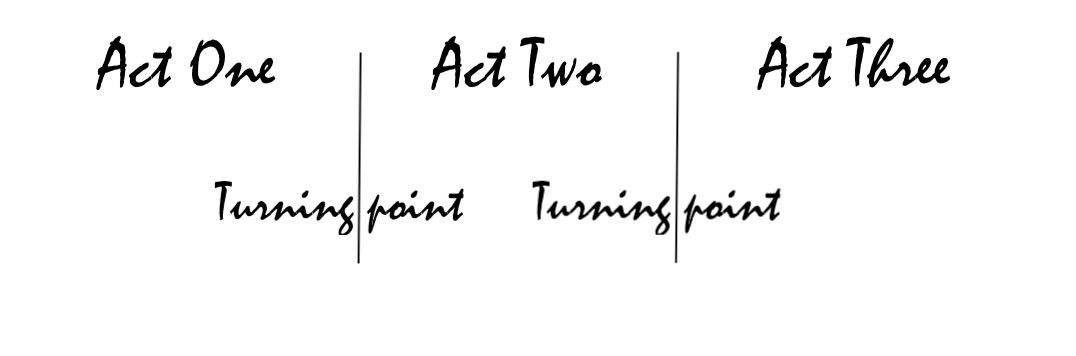
Excerpt from John Yorke: Three-act structure is the cornerstone of drama primarily because it embodies not just the simplest units of Aristotelian (and indeed all) structure; it follows the irrefutable laws of physics. Everything must have a beginning, a middle and an end. Screenwriting teacher Syd Field first articulated the three-act paradigm breaking act structure down to these constituent parts: set-up, confrontation and resolution, with a turning point toward the end of the first (the inciting incident) and second (the crisis) acts.

CORPORATE STORYTELLING

I want to be careful about diving too deep into drama and in screenwriting. My aim here is to use McKee and Yorke to help us figure out storytelling for business. I want to make sure we’re tacking close to the wind. The reasons that this kind of story structure makes sense for us as business writers are several. This approach helps us to ask better questions. What happened? Who’s story is this? Who or what got in the way? How did the protagonist surmount the obstacles? What are the stakes? This way of working points the way to creating something that is compelling. And there’s an underpinning, a framework to build the story on. So I’m going to offer up another story from the Lucid Content archives.


“There is no greater agony than bearing an untold story inside you.” –Maya Angelou


A client of mine is a gardening / nursery company in Eugene, Oregon. The patriarch of the family (let’s call him Frank) founded, owned, and ran the business for years. Their mainstay product are DIY greenhouses. Here’s an abbreviated version of their story.

Frank takes his family on a short vacation. He leaves a small, translucent box, (a fruit tote) upside down on his lawn. On his return, the grass beneath the tote, is thick, rich, dark green. Trapped, warm air created a greenhouse effect. He learns what the plastic is, orders sheets of it, then goes into his home workshop and in short order, builds a sort of backyard, do-it- yourself greenhouse. Presto! Successful family business. Over the years, thousands of units sold and shipped across the country. The business takes over family life, even the the family home. Teenage daughter HATES this business and everything about it. All is going well until… A supplier of the plastic, the very material that the greenhouses are made of, ships defective material. (We have our antagonist.) Many customers are impacted. The business owners by now are older, they’re tired. Everything they have built, including their integrity, their relationship with employees (unusually stellar) is in jeopardy. There’s a lot at stake. They consider shutting down. But wait! But the once recalcitrant daughter is a grown woman. And, surprise, she is a Master Gardener with an MBA in Business. She BUYS THE COMPANY. Her first efforts fail, the crummy manufacturer won’t help her identify which lots were bad, making it almost impossible to find affected customers. She can’t produce the greenhouse kits until she has a better supplier. In the interim, she ships a comparable – competitor product so her customers can get their needs filled. Finally, she finds a new manufacturer, doubles the 10-year warranty to 20, and in the process, finds a way to make whole those customers who had received bad product, and, ushers her parents gently into retirement and shifts her greenhouse kit marketing campaign to…cannabis.

Act I: formation of the company.
Turning point or inciting incident: Manufacturer ships defective materials, company survival at stake.
Act II: Daughter buys the company
Crisis point in Act II: Daughter cannot identify all the customers who got bad product, reputation at stake…ships competitor product…
Act III: Daughter finds new manufacturer, doubles warranty, finds affected customers, makes them whole, parents retire…

Whether we want to structure our stories along certain well-traveled paths or not, it’s often the case that stories organically conform to certain types of structure. Even David Mamet says so.

Excerpt from John Yorke: In simple terms, human beings order the world dialectically. Incapable of perceiving randomness, we insist on imposing order on new phenomena, any new information that comes our way. It’s thesis, antithesis, synthesis. As David Mamet says: ‘Dramatic structure is not arbitrary — or even a conscious invention. It is an organic codification of the human mechanism for ordering information. Event, elaboration, denouement; thesis, antithesis, synthesis; boy meets girl, boy loses girl, boy gets girl; act one, act two, act three.”


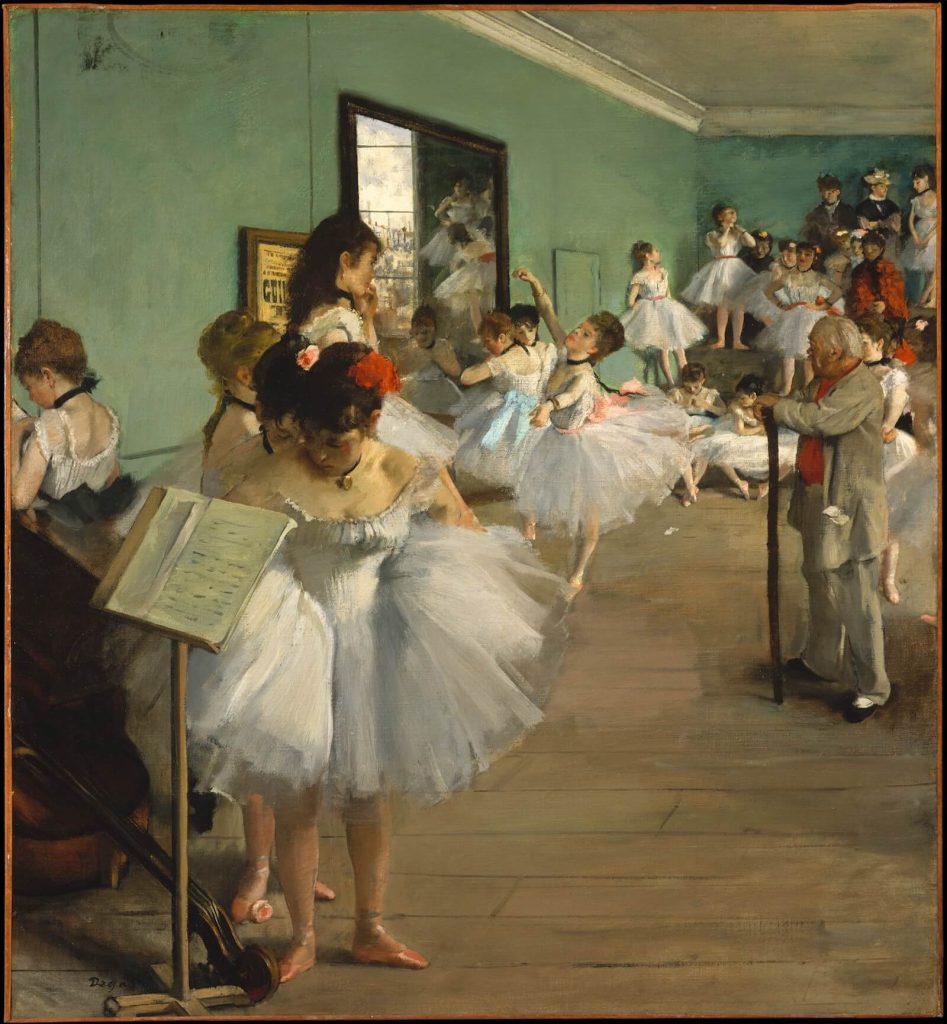
Image credit: The Dance Class, Edgar Degas 1874

Filed Under: Business Communications, Business Writing, Case studies, Corporate Biography, Seattle Freelance Copywriter, Storynomics, Storytelling

Blogging Storynomics 8

June 10, 2018 by Richard Leave a Comment

[dropcap]S[/dropcap]o we’ve been blogging our way through Robert Mckee’s Storynomics: Story-Driven Marketing in a Post-Advertising World. We covered rational and emotional communications in the first post…we talked about the importance of story, the notion that story is the remedy for what ails business communications…we hinted at the difference between narrative and story and then we truly unpacked the narrative – story definitions.

“All great literature is one of two stories; a man goes on a journey or a stranger comes to town.”
― Leo Tolstoy


We talked about human consciousness and how story-making emerged to help humans make sense of everything around them. We touched on the eight stages of story design (rather intricate engineering from the Mind of McKee.) We looked to John Yorke’s book on storytelling, Into the Woods. We got into binary values in storytelling: truth/lies, good/evil, love/hate, success/failure. Time and space showed up in blog post six. And in the last post, number seven, we talked about the inciting incident — the event that launches the story.

This next bit that is coming soon from John Yorke, is quite interesting too. I speak of the Three-Act Structure. But for now, just plain old structure…

Excerpt from John Yorke’s book: I smacked my little boy. My anger was powerful. Like justice. Then I discovered no feeling in the hand. I said, ‘Listen, I want to explain the complexities to you.’ I spoke with seriousness and care, particularly of fathers. He asked, when I finished, if I wanted him to forgive me. I said yes. He said no. Like trumps.

Yorke continues -> ‘The Hand is a chapter in a short story, ‘Eating Out,’ by the American miniaturist Leonard Michaels; it’s also in effect a complete story in itself. If all stories contain the same structural elements, then it should be relatively easy to identify within ‘The Hand’ the building blocks with we should now be familiar.

Protagonist — the narrator
Antagonist — his son
Inciting incident — awareness of no feeling in hand
Desire — to explain his action
Crisis — ‘He asked…if I wanted him to forgive me’
Climax — ‘I said yes. He said no’
Resolution — ‘Like trumps.’

[dropcap]S[/dropcap]o I’d like to jump in here and bring this back to a business story situation. In an earlier blog post, I talked about an inciting incident that involved Boeing 787 aircraft. What happened was that a couple of years after launch, a number of these new aircraft experienced problems…lithium-ion batteries had overheated. The entire fleet — worldwide — was grounded by the FAA. That is an inciting incident for the ages. Here’s the opening to the case study I wrote for Base2 Solutions a few years ago.


The Right Teams Get the 787 Flying Again
Base2 Joins Experts to Help Solve Boeing Battery Issue

Boeing faced a huge operational and public relations debacle. The FAA had grounded the 787 Dreamliner. Incidents involving lithium-ion batteries took place on two separate aircraft. Engineers from Base2 joined teams of experts working to find and resolve the problem.   

When 15,000 people watched the rollout of Boeing’s 787 Dreamliner on July 8, 2007, expectations ran high. The plane was more fuel-efficient than other planes its size. Composite materials made up 50 percent of the primary structure of the plane. And, it relied more on electrically generated hydraulic power for primary flight controls. The first plane shipped in September of 2011.

Then in early January 2013, the FAA grounded the fleet. Two lithium-ion batteries, used for back up power for flight controls, had overheated or vented. The FAA ordered a thorough review by technical investigators.

###


Business stories — and especially case studies — can easily be structured around a time-honored storytelling structure. In this story, is the protagonist the new, but flawed (isn’t the hero always flawed?) 787 Dreamliner? Or is it The Boeing Company? It’s The Boeing Company—whose world has been suddenly turned upside down. It’s The Boeing Company who will have to face down the antagonist or forces of antagonism: the FAA and the problem batteries.

So we already have the beginning ingredients we need for a story. But it gets better. We also have values that arrive in the form of a positive / negative charge. (Ha!) There is success/failure, competence/incompetence, safety/danger and, profit/loss. Right? And by the way there is time and place. The meaning of this story is defined by the period of time that the story describes. Place is simple: the fleet of 787s.

One last point. I loathe the tiresome case study structure of problem – solution – outcome. Just seeing that makes me want to gouge my eyes out. However, that underlying idea that a) something strange or weird or bad happened and b) he/she/they/someone had to work to get things back into balance, and c) balance restored, planes flying again, FAA satisfied, profits and safety secured…it kind of does have a problem, solution, outcome framework underneath it all…

It’s very much a three-act structure, which we’ll dig into more in the next post.

Thanks for reading. 🙂

Photo credit: Icarus, Empire State Building 1930 Lewis Hine photographer

Filed Under: Business Communications, Business Writing, Case studies, Freelance Copywriter, Seattle Freelance Copywriter, Storynomics, Storytelling, Writing Tips

Blogging Storynomics Episode 7

June 6, 2018 by Richard Leave a Comment

If you’re coming into this series of blog posts on storytelling in business, you’ll probably want to head over here >>
I love this quote by Robert McKee so much, I’m posting it again…

The moment a story appears in front of audience members or readers, they instantly and instinctively inspect its value-charged landscape, seeking an emotional door into the story, a place to stick their empathy.” – Robert McKeee

In this episode, we’re going to go into something I find fascinating; the thing that starts it all, the thing that screenwriters call ‘the inciting incident.’ Here’s how McKee defines it.

Excerpt from McKee:
The inciting incident launches a story by upsetting the equilibrium of the protagonist’s life and throwing the story’s core value either positively or negatively, but decisively out of kilter. This turning point initiates the events that follow and propels the protagonist into action.

Excerpt from John Yorke’s Into the Woods:

All stories have a premise — ‘What if….?’

A stuttering monarch takes instruction from a colonial maverick…
A slum dweller from Mumbai is accused of cheating on Who Wants to be a Millionaire?…
A junk-collecting robot is whisked away from his home planet…

An inciting incident is always the catalyst for the protagonist’s desire. It might be useful to think of them as the subject of a film’s trailer: it’s the moment the journey begins.

Yorke goes on to say that the first attempt to codify the inciting incident, or incidents, came in 1808 courtesy of A. W. Schlegel, who called them ‘first determinations.’

When you think of certain well-known films, the inciting incident can be fairly easy (though also quite tricky) to spot. From one of my favorites, The Verdict, here’s a thought about what’s happening around the inciting incident.

Excerpt from Christopher Lockhart’s blog, The Inside Pitch:
For physical/external storyline: MICKEY jolts GALVIN into consciousness, reminding him that he has five-days to prepare for the ONLY case on his docket. This is a definite money-maker that will ensure GALVIN some much needed income (page 6-7).

For psychological/internal storyline: GALVIN visits his comatose client in the nursing home. He comes to understand the severity and enormity of the case before him (page 8).

Notice what’s being said in the above excerpt: for the physical/external storyline…and for the psychological/internal storyline….two worlds operating here, inside and outside…

INCITING INCIDENTS IN BUSINESS STORIES

Excerpt from Scientific American, by Umair Irfan: 

At 10:21 a.m. on Jan. 7, 2013, about a minute after all 183 passengers and 11 crew members from Japan Airlines Flight 008 disembarked at Boston’s Logan International Airport, a member of the cleaning crew spotted smoke in the aft cabin of the Boeing 787-8.

Soon after this event, the FAA ground the entire BRAND NEW fleet of Boeing aircraft. Suddenly, Boeing was in a world of hurt — deep inside that turning point that initiates all the events that follow–in this case smoking lithium batteries. I know about this story because I had to write about a consulting team that worked on this problem. Every imaginable element of good storytelling was available to work with… But the ‘incident’ that launched the story? Overheating, smoking lithium batteries.


Excerpt from New York Magazine piece, by Yashar Ali:

That first (John) Carreyrou story reported that Theranos’s blood-testing machine had significant accuracy issues and had been used for only 15 out of a claimed 240 tests. Subsequent stories revealed that the machines never really worked, would often malfunction, and could lead to inaccurate diagnoses. Today, the investors are gone; Holmes and the former president and chief operating officer of Theranos, Sunny Balwani, who was also her secret boyfriend at the time, are both facing federal criminal investigations, and they have been charged by the SEC with running an “elaborate, years-long fraud.”

The publication of a Wall Street Journal story about serious problems at a Silicon Valley startup–Theranos–was the inciting incident in a cascading nightmare of revelations and crises that would lead to the near total collapse of a completely fraudulent company that had raised $900m from investors. Absolutely amazing story.

Those are high-profile, well-known, public stories. But think about these quieter stories that happen every day:

An administrator at a large university healthcare system is promoted to a position with much more responsibility, and she is not entirely certain she can pull it off. On her own, she contacts an old friend of her father’s, a retired management consultant who coaches her on the quiet. The inciting incident is the new job — the turning point that initiates a series of events that follow…The antagonists in the story are the bureaucracy, and her own self-doubts.

A successful chef-restaurateur opens a new, and fairly large restaurant operation in the midst of an economic crisis. His funding is razor thin. The launch has to succeed right out of the gate because he needs that money to pay rent, vendors, all the rest. He hires a chef to run his kitchen, hires a catering team, servers, a manager; he works with his PR and marketing partners and opening day arrives. Six months in, the chef is declared a failure and is fired. The checking account is on empty. The first review is decidedly ho-hum, if not outright hostile. The chef dons his whites, sharpens his knives and returns to the kitchen, something he has not done in years. He saves the restaurant, and sets it on a profitable footing that supports the establishment for years and at the same time, develops a management and funding framework that serves him well as he opens three more restaurants in the coming years. The inciting incident? The chef who failed and put the entire enterprise at risk.

Thanks for reading, more storytelling for business to come.

Illustration: Wheat Field with Cypresses, Vincent Van Gogh

Filed Under: Business Communications, Business Writing, Freelance Copywriter, Stories, Storynomics, Storytelling, Uncategorized

Blogging Storynomics 6

May 30, 2018 by Richard Leave a Comment

[dropcap]T[/dropcap]he moment a story appears in front of audience members or readers, they instantly and instinctively inspect its value-charged landscape, seeking an emotional door into the story, a place to stick their empathy.” – Robert McKeee

Have to say, I love that quote. It reminds me of the film The Verdict, by Sidney Lumet, starring Paul Newman. A washed-up, alcoholic, ambulance chasing attorney, goes into battle with the medical and legal establishments to try and deliver old-fashioned justice to the family of a woman who died while in hospital. What a story.

So we’re into our sixth post on Robert Mckee’s book on storytelling and business, Storynomics: Story-Driven Marketing in a Post-Advertising World. In this section, McKee gets into laying the groundwork for how stories are made. As to audience, he writes that fiction writers and comedy writers have well-tuned antennae for how to reach their audience. In marketing, it’s different and far more demanding. (No kidding.)

Some of this material is, well, bloody obvious, and I’m going to bullet point some of the text.

Subject matter for a story contains three major components: a physical and social setting, a protagonist, and a core value.

World-building is storytelling’s critical second step. The weakest choices of all favor the general over the specific.

TIME

McKee is weak here. A definition of time in storytelling needs to be a lot stronger than a few crumbs about duration and location. Time is a hugely important consideration in fiction, far more important that McKee suggests. In The Art of Time in Fiction, Joan Silber writes, ‘…a story is entirely determined by what portion of time it chooses to narrate. Where the teller begins and ends a tale decides what its point is, how it gathers meaning. Yogi Berra’s famous bit of hope about a ball game—it ain’t over till it’s over—is the storyteller’s dilemma. When is it over?” This is exactly right and as I read those words I think of my friend John Simmons book, Spanish Crossings, which is about time as much as it is about love and honor. Back to McKee.

SPACE

Excerpt from McKee

Two dimensions structure a story’s space: Physical—the horizontal landscape and every object in it. Social—the vertical hierarchy of a society’s pyramid of power and the possibility of movement up or down.

THE CORE VALUE

Excerpt from McKee

“…a setting does not become three-dimensional until the teller adds substance in the form of values. As mentioned in chapter 3, in everyday conversation, when someone says an individual or institution has “values” he means positive qualities such as truthfulness, love, generosity, hard work, loyalty and the like. But for the story-maker, the values he invests in his telling come not as singularities but binaries of positive/negative charge: truth/lie, love/hate, generosity/selfishness, hard work/laziness, loyalty/betrayal, life/death, courage/cowardice, hope/despair, meaningfulness/meaninglessness, justice/injustice and the list goes on.

 A telling may incorporate any number, variety, and combination of values, but it anchors its content in one irreplaceable binary—the story’s core value. This value determines a story’s fundamental meaning and emotion.

More to come, thanks for reading.

Filed Under: Business Communications, Seattle Freelance Copywriter, Storynomics, Storytelling, Uncategorized

Blogging Storynomics 5

May 23, 2018 by Richard

[dropcap]W[/dropcap]elcome to post 5 in an ongoing, and totally fascinating (if I say so myself) exploration of Robert McKee’s new book, Storynomics: Story-Driven Marketing in a Post-Advertising World. In our last post we, I, excerpted McKee on the difference between narrative and story. Narrative is the guy at the bar, the friend at the cafe, who drones on and on and on in a numbing recitation of all the stuff that happened when he went to Vegas or wherever. We’ve all been there.

I’m going to change things up a little in these posts, by adding in some work by the great John Yorke, who wrote a very, very good book, Into the Woods: A Five-Act Journey Into Story. Here’s McKee and Yorke on story.

But what is a story? 

Excerpt From McKee:

The essential core in all stories ever told in the history of humankind can be expressed in just three words: conflict changes life. Therefore, the prime definition becomes: a dynamic escalation of conflict-driven events that cause meaningful change in a character’s life.

Excerpt from Yorke:

Storytelling, then, is born from your need to order everything outside ourselves. A story is like a magnet dragged through randomness, pulling the chaos of things into some kind of shape and – if we’re lucky – some kind of sense. Every tale is an attempt to lasso a terrifying reality, tame it and bring it to heel.

[dropcap]T[/dropcap]his section of McKee’s book gets pretty deep into the weeds and I’m not going dwell here too terribly long. But for the purposes of shedding some light on his thinking, here it is. Personally, I find all this a bit much, slicing the apple to death. But it’s worth looking at what McKee says about ‘meaning’ as he concluded this section. See below.

THE EIGHT STAGES OF STORY DESIGN

Stage One: The Target Audience
Stage Two: Subject Matter
Stage Three: The Inciting Incident
Stage Four: The Object of Desire
Stage Five: The First Action
Stage Six: The First Reaction
Stage Seven: The Crisis Choice
Stage Eight: Climactic Reaction

Excerpt from McKee:

The eight stages of storytelling create meaning in this way: First, at the core of all stories pulses at least one binary value–such as life/death, freedom/tyranny, success/failure, truth/lie, love/hate and the like. Second, the dynamic of cause and effect within the story’s events expresses the how’s and why’s, the ‘because’ of change. Examples: Indiana Jones lives to fight another day ‘because’ under pressure, he is courageous, cool and smart; Winston Smith submits to tyranny ‘because’ he is vulnerable to the cruelty of Big Brother; the A’s win the pennant and Bill Beane saves his career ‘because’ he never loses faith in his judgement. The clear, simple statement of value plus cause expresses a story’s meaning in one sentence.

I’m currently involved in a fascinating writing project with 100 writers. One of the things that’s popped up is someone’s fascination with the facts of a certain person’s story. I argued that it was less the facts that were compelling but what the facts signified, what they revealed about character and inner life. I think that’s what McKee is saying. The fact that Indiana Jones lives to fight another day is sort of interesting, but the real story is beneath that. He lives to fight another day ‘because’ of who he is, what’s he’s made of, his courage.

Filed Under: Business Communications, Business Writing, Freelance Copywriter, How to Write Better, Stories, Storynomics, Storytelling

  • Page 1
  • Page 2
  • Go to Next Page »