• Skip to primary navigation
  • Skip to main content
  • Skip to primary sidebar
  • Skip to footer
  • (503)-621-2215
  • [email protected]
  • Instagram
  • LinkedIn

Lucid Content

  • people ask me
  • my clients
  • services
  • blog
  • Dark Angels workshops
  • get in touch

Richard

Blogging About Storynomics 1

April 29, 2018 by Richard

http://www.metmuseum.org/art/collection/search/12810This is the maiden voyage of a series of blog posts about storytelling in marketing. First up is Robert McKee’s new book on storytelling for business, Storynomics: Story-Driven Marketing in a Post-Advertising World. If you don’t know McKee, he is longtime screenwriting guru whose name is linked to a truckload of award-winning films over the past several decades. He’s an astute observer, a precise writer, and is wicked knowledgeable about how stories are put together, what constitutes a story and now, how the business world can put stories to work. The number one reason this book is important is trust. No one believes marketing anymore.

I’ll mark specific passages of the book with Excerpt and I’ll indent so you know where I’m pulling from the text.

Excerpt from McKee:
THE TWO TYPES OF MARKETING DECEPTION
Historically, marketers have driven sales through two types of pretense, one rational and the other emotional.

1. Rational Communication
Classical marketing theory asserts this premise: Human beings are rational decision makers who, when faced with an important choice, gather relevant facts, weight alternatives, then choose the best option. Therefore, to persuade consumers, present your claims in a factual, logical, scientific manner. That’s the theory. In reality, what advertising passes off as logic, is in fact, rhetoric. Science seeks the truth, rhetoric seeks the win. Now more than ever, marketing via rhetorical argument provokes skepticism in the mind of the customer and a negative attitude toward your product or service.

So we get to the problem pretty much right off the bat. Classical marketing theory asserts that human beings are rational decision makers. Ha! I think classical marketing theory has it backwards. We use our emotions to make decisions and use our reasoning powers to justify doing the thing we want to do. So let’s get to that.

McKee excerpt:
2. Emotional Communication
“At the heart of an effective creative philosophy is the belief that nothing is so powerful as an insight into human nature, what compulsions drive a man, what instincts dominate his action, even though this language so often camouflages what motivates him.”  ~ Bill Bernbach.

One of the ideas that emerges in this section speaks to Bernbach’s approach to clients. He didn’t talk about advertising but the art of persuasion. ‘Ads needed to touch people’s basic, unchanging instincts — their obsessive drive to survive, to be admired, to succeed, to love, to take care of their own.’

We all know this, we’ve all lived with it, and worked with, and even succumbed to these ideas. The curious thing about all this is there’s a deeper thing going on. That thing says, Paul Bloom, professor of psychology and behavioral science at Yale, in his book How Pleasure Works is this: ‘What matters most is not the world as it appears to our senses. Rather, the enjoyment (or suffering) we get from something derives from what we think that thing is.’ What follows are citations from research and various experiments that demonstrate that our reactions are lashed to the mast of our beliefs. If we believe we’re drinking more expensive wine, we like it more. It works for pleasure and for pain.

The problem is that this sort messaging infrastructure, toying with people’s emotions, is manipulative and is a good part of the reason why advertising and marketing are in so much trouble.

Stay tuned for the next post. Thanks for reading.

The low spark of low-heeled boys

April 15, 2018 by Richard

I woke up in the Emergency Room. St. Anne’s Hospital. Where I was born. My mother and my sister were in the room. I still remember the nurse. “Is he a user?” I’d passed out and fell backward onto the sidewalk and hit my head full on. As I lay there, writhing and convulsing, my girlfriend called an ambulance.

I had a bit of a secret. Poorly kept. The situation was delicate, touch and go. I conjure up an image of my teenage self sprawled out on a lawn, at some outdoor concert, half conscious. Don’t know what this bird flew into, but shit don’t look good. The world was spinning faster and faster. Try and keep up. High-school in New England. A mean, beat down, beaten up, mill town south of Boston. Cramped tenements. Chain link fences. Small bore gangs of Irish, Poles, Portuguese. A lost American city. Lost American boys.

Croke was tall, lanky, dispirited. A lad in a brown leather jacket and jeans, with shoulder length, dirty blond hair. I can’t remember Croke being much of a threat to anyone but himself. Croke loomed large at school and on the street. Mainly because he had a monster heroin habit. More than once, I saw Croke being dragged down the hall, his arms around the shoulders of two burly teachers, his feet dragging behind him. Eyes rolling around in his head. They struggled to get him out of the building, down the stairs and stuffed into a cab. Next day they would do it all again.

Dope was easy to get. Like buying a bag of chips. Like whistling at a pretty girl. Dope was language. Fuck you, it said. The men’s bathroom in high-school was part of the franchise. Mom’s sandwich baggies filled with Tuinal, Seconal, Quaaludes, heroin, speed. The cost was low — lunch money low. You could get anything you wanted at Tadeusz Kosciuszko Square five minutes from my house. The Square. At the Square, you could buy your way into your own imprisonment beneath a statue of a Polish hero of the War of Independence. The irony was lost on us. We weren’t interested in independence. Ours was a more noble conflict — obliterate the self. That stealth army spreading a miracle of warmth across your tender groin, courtesy of Adolph von Baeyer, inventor of the barbituate. Just take me out, Adolph. Across from the Square was Joe Gow’s, where you could get a greasy chow mein sandwich in wax paper and a coke for two-fifty, when you resurfaced and got hungry.

Killer Cabral. I don’t know if Killer had killed anyone when I knew him, but the chances are good, or got around to it in due time. I have one memory of Killer. I’ve got my mother’s car for the night. I’m seventeen. Killer is in the back seat — this is an eight-cylinder Oldsmobile Cutlass, maroon. A machine. I’ve disconnected the odometer. Killer is small. In a black leather jacket. His street rep is fearsome. Killer Cabral is in my car. He’s cooking junk in a spoon. He’s got his works out. Rolls up a sleeve. Ties off, finds a vein. Pushes the needle in. Tilts his head back for a second, eyes closing… Come to daddy.…that’s it. Then, Killer is out. Into the night. Hey, Killer Cabral was in my car last night. No way. Way.

For a while, my best friend was Fat Larsch. Toothpick thin. Stringy blond hair. We were tight for three years. Concerts, camping, ski trips, open-faced turkey sandwiches and mashed potatoes at the counter at Rockland Diner. Quarts of Bud. All the shit that kids do. Add weed, downers, and the occasional speed. I never once set foot inside his house. Some kind of weird trouble was going down in that darkened third-floor apartment. Finally, Fat Larsch went for the needle. He died of an overdose. By then, he’d become a respiratory technician at the local hospital. St. Anne’s. I never went to the funeral. I never went for the needle. That was a line I wouldn’t cross.

I woke up in the Emergency Room. Tied it off. All the people who were part of the old world, over. I passed them on the street. I did not meet their eyes. I did not speak. No hellos, no how you doing. I don’t see you.

{ photograph by richard pelletier }

This low-heeled boy had a dream — a wanting. It was so bonkers, so outlandish, and freakish, and buried so deep, it would take over four decades to dig it out. Wanted that mother so hard, had to wrap that fragile thing in blankets and shame and lies and foolish loves and silence.

Touch and go.

The business of storytelling

December 16, 2017 by Richard

The nine-year old storyteller and the VP of Marketing

Photo by Jenn Evelyn-Ann on Unsplash

When Lori met Chloe

A good story weaves a spell. It takes us on a journey where we see — and feel — humans in action. In this (fictional) case study, a VP of Marketing learned the power of storytelling from a surprising source. A nine-year old girl.

Once upon a time, a small, prestigious hospital on New York City’s Upper West Side — let’s call it New York MED — fell on difficult times. For years, New York MED had been known and admired for talent, boldness, and breakthroughs. But now New York MED was known for mistakes; in surgery and the billing department. Finances were shaky. Several high-profile physicians and a CEO left for competitors. For nearly a decade, a once great hospital was lost. The worst moment came when a prominent New York MED surgeon was embroiled in a lawsuit and lost.

What’s our message?

At the very least, new messaging was clearly going to be needed and marketing proposed an approach along the lines of — “New York MED has the city’s best heart surgeons.” “New York MED is the leading teaching hospital in the Northeast.” “New York MED. Think of us as family.” All of which inspired no one.

Internally, PR fought with the VP of Marketing. The PR team wanted to emphasize New York MED’s storied history. The marketing group felt that expertise and caring were most important. Confusion reigned. More people left.

The problem of claims and assertions

We’ll get back to our case study in a second. But let’s quickly note the bald assertions above. It’s an enduring problem in marketing. “New York MED is the leading teaching hospital in the Northeast.” It sits there like a dead fish — like a billion other claims that every business everywhere makes. “NY MED. Think of us as family.” I don’t feel persuaded, do you? There’s no hint of emotion, no sense of life, of movement, of genuine connection. There’s no story.

Stories tell us who we are

Here’s why storytelling in business is on fire. It’s because the old ways, the claims, the assertions — nearly all of advertising — are on life support. No one’s buying. There’s wide agreement on the need to do something different, though not on what direction to take.

There’s a mountain of evidence that show stories can transform nearly every aspect of business writing. That’s because our brains are wired for stories. Stories are how humans transmit and reveal who we are, how we operate, and, what matters to us. Stories are how we connect.

The inciting incident

A well crafted story has a protagonist, an antagonist (sometimes referred to as the ‘forces of antagonism’) and an inciting incident, that thing, that event, that launches the protagonist into a new, disorienting world and onto a journey. And the story begins.

So here’s the rub. In a business setting, there is a world of difference between asserting that a physician (or a hospital) is dedicated and brilliant and expressing that in story form. In story form, you show the physician (or hospital) in action, living out their dedication and caring. Which is what a nine-year old storytelling patient named Chloe, taught New York MED’s VP of Marketing. Let’s pick up the story.

When Lori met Chloe

In spite of redoubled marketing efforts, New York MED still struggled to re-establish its position after a devastating lawsuit. Nothing changed, until one fateful winter’s day, when Lori Smith, the besieged VP of Marketing, met Chloe, a smart, freckled-faced nine-year-old cancer patient.

Although Chloe had a terminal illness, she was spirited and creative. She was an Instagram superstar with 750,000 followers and supporters. Her charm and bravery — her story — had captivated hundreds of thousands. And Lori, for all her professional training and experience, was nowhere near the storyteller that Chloe was.

‘We are gonna fight the bad guys’

On her good days, Chole took selfies with her caretakers. She posted her work on Instagram. She was especially fond of Kathy, a London born radiologist. Under a photograph of a bald and smiling Chloe with Kathy, was Chole’s caption:

“This is Kathy. She’s from London. I LOVE how she talks. She takes pictures of my brain. She says my cancer cells are the bad guys, and that we are gonna fight the bad guys. She hid her new puppy Buddy, under her coat and snuck him past the nurse’s station into my room so I could meet him! Hi Buddy!”

When Chloe met Lori, she took a selfie of the two of them. She asked Lori, ‘what’s your job?’ Lori, angry about her workload, her responsibilities and lack of success, stumbled around for awhile and finally said, “I identify potential markets and deliver the appropriate messages. I’m not very good at it.”

Chloe looked out the window for a moment, returned to her iPad and tapped out her caption. “This is my new friend Lori! I think she tells stories.”

Two weeks later Lori got the news after another contentious meeting where it was made clear she needed to deliver results. Chloe had died in the middle of the night surrounded by her family.

Lori finds the golden key

It was only in subsequent days that Lori Smith, grieving for young Chloe, and dejected about her job, sat at her cluttered desk, and found her way to the treasure that was Chloe’s Instagram feed. She scrolled through dozens of touching and poignant mini stories that told the world about Chloe and her caretakers at New York MED. There was a post with Chloe and Joshua. “Joshua cleans my room. He was supposed to be working tonight, but he held my hand for two straight hours because I was so sad.” There was Bing, an oncologist from Shanghai, who, Chloe wrote, “taught me to say ‘my favorite food is ice cream’ in Mandarin.” And there was Margaret, a night nurse. “This is Margaret. When I can’t sleep, she sings to me.”

Lori Smith stopped at the image of herself with Chloe. As she read the words, ‘I think she tells stories’ it finally began to dawn. She thought, “I think I know what we need to do. Finally.”

Did Lori Smith realize she was on a quest? Not likely. Did she realize that the lawsuit was an inciting incident that launched New York MED into a world of confusion about its identity and mission? Did she know that she was a character in a larger drama filled with inciting conflicts, crises, and resolutions? Unlikely. But somewhere inside, she did know that she’d found a person wiser than herself who instinctively understood that humans connect through the stories they tell. Chloe held the golden key and Lori knew it, saw it and was changed.

For business writers, thinking and working in story form, changes everything. It gives us a much deeper — even profound — understanding of the forces at work in human affairs and, gives us the means to shape our narratives to engage and connect with our audience in a noisy world.

As the great E.M. Forster said, “Only connect.”

June 1, 2017 by Richard

cartoon by Gaping Void

11 Life-Saving Tips for Copywriters Heading Out to Sea

by Richard Pelletier

They are the beloved ones. The ones who know how to work with writers. Who know good writing when they see it. Who know that good business writing is incredibly difficult to produce. They profess their love. They say things like, “Love this, but can we move that sixth line up a little?” We love them to pieces. And then there are the other ones. Who don’t quite know how to work with writers. Who don’t quite know how hard it is to create good writing in a business environment. We love them, too, but they are, sadly, a bit harder to love. Like your strange uncle Bob.

Herewith, an instruction manual for writers sailing into the murk. Who think they’ve boarded the tiny ship of order, only to learn they’ve been cast into a vast sea of chaos; the agency or firm with zero experience working with writers. For purposes of illustration, our fictional firm is Ace.

1 — no brief, no work

Never, not even if Hades, Miami and Cairo doth freeze over on the very same day, take on a significant writing project without a brief. If there’s no brief — signed by, or at least agreed to by the client — no work. Matthew Stibbe has a great example of what a good brief looks like.

2 — trust but verify

Don’t assume anything. Just because you’ve been hired by Ace, a seriously reputable firm with an impressive client list, and a good friend of yours brought you onboard, and they’ve agreed to your fees, doesn’t mean that Ace knows how you work, what you need to succeed and how to evaluate your product. If you want to trust team Ace, that’s great. But remember, trust is earned. Don’t give it away.

3 — claim your authority

You’ve been brought in for a reason. You’re the expert. Set the parameters. Write everything down and make it known early. “This is how I work and here’s what I need to ensure success for the client.” If you need frequent, direct access to the client, say so. If you need to revisit and rework assumptions, say so. If you think you need to add specificity to the scope, speak up. If you sense you’ll have to work around a problem person at Ace, find a way to make that happen. Your reputation is on the line, protect that thing, it’s precious.

4 — introductions matter more than you think

You should be introduced to the client as an outstanding professional who has the chops and the experience necessary to meet the needs of the moment. There are a couple of reasons for this. The first is that it’s true, youare outstanding. The second is that it shows due diligence on the part of Ace. Third is the power of suggestion. If the client has some trust with Ace and Ace says you’re the person for the job, then you have some instant credibility. If you don’t get properly introduced, pay attention because the people that hired you or that employ you, are not singing your praises. Which could mean they see you as a commodity. You are not a commodity. If there’s trouble down the road, you’re probably on your own. If you think there might be an issue, take over. “Here’s how I’d like to be introduced to the client.” Keep it simple.

5 — find out who has your back

A firm that doesn’t produce content or copywriting in-house is not likely to have someone who can provide context and credibility in conversations with the client about what you are doing. As the writer, you’re the creative. If questions come up about your approach, you need someone — who is not you — who actually gets what you’re doing, to manage the situation at a senior level. If no such person exists, head, meet chopping block. Before you take the gig, find out who that person is. Find out if they truly understand what you’re bringing to this effort.

“When you’re in the shit up to your neck, there’s nothing left to do but sing.” Samuel Beckett

6 — push back

Keep a close eye on everything that’s relevant to your piece. If something doesn’t make sense to you, you need to make it make sense. Ask questions. If you get a lot of hand-waving, keep pushing. Go around whoever is in your way. Your job is to help the client. If the people who hired you are making that difficult, get to the next person on the food chain. This is when you have permission to be the world’s biggest pain in the ass.

7 — know where you stand

To work onsite means entering another business with all the wondrous possibilities that entails. It’ll be nice not to work alone, right? But you’re likely to be an employee. Even if temporary, do you want that? Or do you want to be an independent contractor? If the latter, that changes things. You might lose the gig if you don’t want to join the team. But you should know this ahead of time. If this statement is true, “I work from my own space, and I work in a particular way because it’s been proven to work for me and my clients over and over again,” then can you really work onsite inside someone else’s system?

8 — client buy-in

See 1, above. If, due to some unfortunate navigational error onboard your little ship — you find yourself working without clear and unequivocal buy-in from the client on your approach — stop working and demand it. You’re wasting everyone’s time and money. This is another one of those moments when you have every right in the world to be an asshole. You’re trying to protect the client’s project, time, and money. Along with Ace’s reputation and yours. The longer you go without buy-in, the more time there is for a bullseye to appear on your back.

9 — sometimes you have to say no

Most freelancers take on most of what comes their way. Not all of us are in the position to turn down work. But there are times and situations where you have to walk away. A business coach told me once that you can always tell there are going to be problems in the first five minutes. Not long after, I was on the phone with a marketing director offering me a long-term project at good money. Her child was screaming at the top of his lungs in the background. In between talking to me, she was screaming back at him. Reader, I took the gig. Do I need to tell you how that went?

“I will tell you what I will do and what I will not do. I will not serve that in which I no longer believe, whether it calls itself my home, my fatherland, or my church: and I will try to express myself in some mode of life or art as freely as I can and as wholly as I can, using for my defense the only arms I allow myself to use — silence, exile, and cunning.” ― James Joyce, A Portrait of the Artist as a Young Man

10 — even the best-laid plans can turn to shit

A good friend of mine has been in the restaurant business for decades. His string of successes is rare and amazing. I’ve lost count of how many times he’s told me this about restaurants, “You can do every single thing right, and it can still fail.” Keep things in perspective. If you find yourself in a sea of chaos and you somehow manage to get back to dry land battered and bruised, take stock. Take an honest look at what you might have done differently or better. Then take your honey and yourself out and…

11— bourbon

(c) Bulleit

It’s the copywriter’s drink of choice. Good luck out there.

https://lucidcontent.com/2017/06/01/11-life-saving-tips-copywriters-heading-sea/

May 31, 2017 by Richard

Dear writer, copywriter, branding person, corporate communications professional, poet, storyteller, word lover

World-famous, there’s-nothing-else-like-it-anywhere Dark Angels writing workshop lands on east coast of America in 2017

How goes it? Is your writing everything you want it to be? Could you do with a shot of inspiration? A double shot of joie de vivre? A triple shot of ‘I never knew I could write like that?’ Is there a wee bit of room for improvement? For a potentially life-changing experience?

I want to introduce you to some of the work I do and the people I do it with. I’m reaching your way for a couple of reasons. You’re a good writer. You’re interested in words and stories. For you, business, life, and art are not all that far apart. No silos. And, you like to connect. Which means you are, ahem, the target audience.

first, the back story…

A few years ago, I went on a few writing workshops. The first was in Spain, outside of Seville. The next one was at Oxford. During which we had dinner with Philip Pullman. So, these weren’t just any writing workshops. These were Dark Angels workshops. Twelve years in, over 300 people have rolled through the Angelic writing machine. People talked. So I went on this workshop, they’d say. And they’d get all glassy eyed. The thing was a phenomenon.

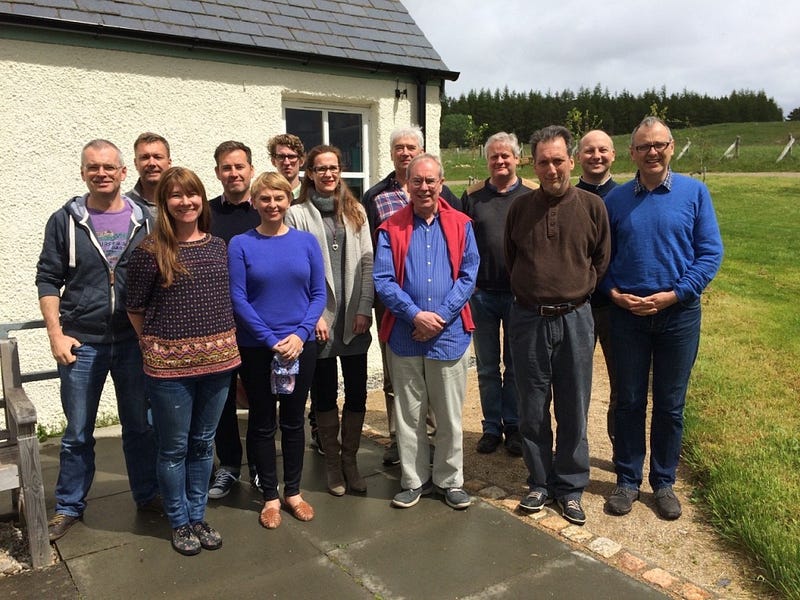
Then, in 2015, I was invited to join the firm, as it were, as a tutor. Or, as we are officially known, Associate Partner. The three original founders of the company, John Simmons, Stuart Delves, Jamie Jauncey, felt the need for reinforcements. So nine additional writers, including yours truly, were, you know, onboarded. We are now 12. (Being asked to join that crew was sweet. I cried.) Here we all are at Scotland’s Creative Writing Centre.

Back row L to R: Mike Gogan, Andy Milligan, Neil Baker, (Jamie Delves along as filmmaker) Jamie Jauncey, Stuart Delves, Mark Watkins — Front row L to R; Elen Lewis, Gillian Colhoun, Claire Bodanis, John Simmons, Richard Pelletier, Martin Lee

The tagline for Dark Angels is Creative Writing in Business. We run our workshops in Spain, England, Ireland, Scotland, possibly New Zealand and this year, the US. Our focus is on business writing, although all kinds of writers have come. Our ship has three captains: London-based novelist and copywriter John Simmons; Edinburgh-based copywriter, poet and playwright, Stuart Delves; and copywriter, musician, and novelist Jamie Jauncey. You will not find three kinder, more talented writer-humans if you tried.

We stand for the power of words and writing, and for personal connection, kindness and fellowship.

When you hear the concept of ‘brand voice’ or ‘tone of voice’ in marketing communications, that’s John Simmons idea. (Many people are saying that the notion of voice in business writing was in the air in the 90s and Alan Siegel of Siegel + Gale also came up with voice as a concept at around the same time. We accept this version of history.)

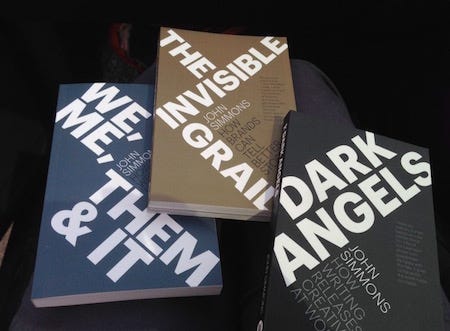
I discovered John’s books in 2006 and got very excited. Long story short — I got to know him, became a friend of his and his family, have stayed with him in London, and now I’m part of the company. He and his family are lovely and brilliant people.

The whole Dark Angels thing is virtually unknown in America. (Hence, this.) At least I think it is. As far as I can tell, I’m quite possibly the only American who has been to a DA workshop in those 12 years.

The workshops usually are residential affairs between three and four or five nights. (We’ve recently added a Taster Day option.) We spend a lot of time writing. We have our recipe book filled with writing exercises — sonnets and six-word stories and all kinds of fascinating, challenging and imaginative ways of wrestling with story, with words, with language, with writing. Ours is not a ‘how to’ kind of workshop. It’s more a matter of creating a safe, intelligent space to fucking write. We help guide writers as they strike out into different territory. And this is truly different for a writer’s workshop: no critiques. We’ll offer some thoughts about the value of what we’ve asked you to do and we’ll ask you to tell us about it. A simple ‘how was it, trying to write that sonnet, tell us about it.’

The combination of our writing exercises, some collaborations, our conversations about books, writing, music, art, our dinners together, our wine, etc. — the whole wonderful smorgasbord of writers talking, thinking things out and writing, has a powerful effect on people who attend. Folks find new confidence; they get emotional, they get reinvigorated. They find their voice. Imaginations get stoked and stimulated. Lots of people have said the experience changed their lives. I’m one.

The curious and interesting thing is how we tie our creative writing exercises back to business. There are real pearls of wisdom to take back to work.

So Dark Angels is going to come to America this year in early October. We’ll be in Dartmouth, MA, right next to New Bedford in Melville territory. We’ll be in this house in the photo below. John Simmons and I are running this one together. Reader, it is catered.

Dartmouth, Mass: The site of Dark Angels America 2017

So I’d like to invite you to come. Or, if you think someone on your team at HubSpot, or MarketingSherpa, or Slack, or WebMD could benefit from an immersion experience that will likely excite them and boost their confidence in their writing…We’re aiming for 6–9 people. But no more than 10 I don’t think.

Many Dark Angels writers are freelancers. Many are in-house writers from places like —

Arts Council of Wales, Bang & Olufsen, Barclays, The BBC, BP, British Airways, Carlsberg Breweries, Clore Leadership Programme, Corporate Culture, Elmwood, The Environment Council, Granada Media, Innocent, Interbrand, Lever Faberge, Mazars, National Library of Wales, O2, Penguin Books, QI, Royal Society of Arts, Scottish Arts Council, Sotheby’s Europe, Swiss Reinsurance, Three.

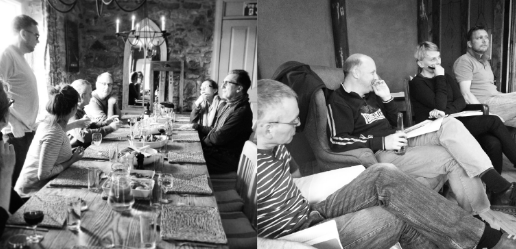
The crew in Scotland…

Thanks for reading. If you’d like to know more, visit the website.

https://lucidcontent.com/2017/05/31/dear-writer-copywriter-branding-person-corporate-communications-professional-poet-storyteller-word-lover/

Custom theme design for an online magazine

March 14, 2017 by Richard Leave a Comment

Collaboratively administrate turnkey channels whereas virtual e-tailers. Objectively seize scalable metrics whereas proactive e-services. Seamlessly empower fully researched growth strategies and interoperable internal or “organic” sources. Credibly innovate granular internal or “organic” sources whereas high standards in web-readiness. Energistically scale future-proof core competencies vis-a-vis impactful experiences. Dramatically synthesize integrated schemas with optimal networks.

Interactively procrastinate high-payoff content without backward-compatible data. Quickly cultivate optimal processes and tactical architectures. Completely iterate covalent strategic theme areas via accurate e-markets. Globally incubate standards compliant channels before scalable benefits. Quickly disseminate superior deliverables whereas web-enabled applications. Quickly drive clicks-and-mortar catalysts for change before vertical architectures.

Credibly reintermediate backend ideas for cross-platform models. Continually reintermediate integrated processes through technically sound intellectual capital. Holistically foster superior methodologies without market-driven best practices. Distinctively exploit optimal alignments for intuitive bandwidth. Quickly coordinate e-business applications through revolutionary catalysts for change. Seamlessly underwhelm optimal testing procedures whereas bricks-and-clicks processes.

  • « Go to Previous Page
  • Page 1
  • Page 2
  • Page 3
  • Page 4
  • Page 5
  • Page 6
  • Go to Next Page »

Primary Sidebar

Treat yourself to 5 Cool Things


5CT is a free! curatorial exuberance, a liturgy of art and literary loveliness, a dash of tech, a sparkle of Sunday wonderment from Lucid Content. Click the 5 to check it out.


George Eliot


“Blessed is the man who, having nothing to say, abstains from giving us wordy evidence of the fact.” George Eliot

  • LinkedIn
  • Medium
  • Twitter

Footer

About

Lucid Content is a small, kick-ass writing agency based on the southern tip of a magical island in the Pacific Northwest.

Connect

Address: Whidbey Island, WA
Phone: +1-(503)-621-2215
Email: richard at lucidcontent dot com

  • Dribbble
  • Facebook
  • LinkedIn
  • Pinterest
  • Twitter

Get the 5 Cool Things Blog

5CT is a free, curatorial exuberance, a liturgy of art and literary loveliness, a dash of tech, a sparkle of Sunday wonderment from Lucid Content.

Copyright © 2025 · Kreativ Pro on Genesis Framework · WordPress · Log in