• Skip to primary navigation
  • Skip to main content
  • Skip to primary sidebar
  • Skip to footer
  • (503)-621-2215
  • [email protected]
  • Instagram
  • LinkedIn

Lucid Content

  • people ask me
  • my clients
  • services
  • blog
  • Dark Angels workshops
  • get in touch

Richard

Blogging Storynomics Episode 7

June 6, 2018 by Richard Leave a Comment

If you’re coming into this series of blog posts on storytelling in business, you’ll probably want to head over here >>
I love this quote by Robert McKee so much, I’m posting it again…

The moment a story appears in front of audience members or readers, they instantly and instinctively inspect its value-charged landscape, seeking an emotional door into the story, a place to stick their empathy.” – Robert McKeee

In this episode, we’re going to go into something I find fascinating; the thing that starts it all, the thing that screenwriters call ‘the inciting incident.’ Here’s how McKee defines it.

Excerpt from McKee:
The inciting incident launches a story by upsetting the equilibrium of the protagonist’s life and throwing the story’s core value either positively or negatively, but decisively out of kilter. This turning point initiates the events that follow and propels the protagonist into action.

Excerpt from John Yorke’s Into the Woods:

All stories have a premise — ‘What if….?’

A stuttering monarch takes instruction from a colonial maverick…
A slum dweller from Mumbai is accused of cheating on Who Wants to be a Millionaire?…
A junk-collecting robot is whisked away from his home planet…

An inciting incident is always the catalyst for the protagonist’s desire. It might be useful to think of them as the subject of a film’s trailer: it’s the moment the journey begins.

Yorke goes on to say that the first attempt to codify the inciting incident, or incidents, came in 1808 courtesy of A. W. Schlegel, who called them ‘first determinations.’

When you think of certain well-known films, the inciting incident can be fairly easy (though also quite tricky) to spot. From one of my favorites, The Verdict, here’s a thought about what’s happening around the inciting incident.

Excerpt from Christopher Lockhart’s blog, The Inside Pitch:
For physical/external storyline: MICKEY jolts GALVIN into consciousness, reminding him that he has five-days to prepare for the ONLY case on his docket. This is a definite money-maker that will ensure GALVIN some much needed income (page 6-7).

For psychological/internal storyline: GALVIN visits his comatose client in the nursing home. He comes to understand the severity and enormity of the case before him (page 8).

Notice what’s being said in the above excerpt: for the physical/external storyline…and for the psychological/internal storyline….two worlds operating here, inside and outside…

INCITING INCIDENTS IN BUSINESS STORIES

Excerpt from Scientific American, by Umair Irfan: 

At 10:21 a.m. on Jan. 7, 2013, about a minute after all 183 passengers and 11 crew members from Japan Airlines Flight 008 disembarked at Boston’s Logan International Airport, a member of the cleaning crew spotted smoke in the aft cabin of the Boeing 787-8.

Soon after this event, the FAA ground the entire BRAND NEW fleet of Boeing aircraft. Suddenly, Boeing was in a world of hurt — deep inside that turning point that initiates all the events that follow–in this case smoking lithium batteries. I know about this story because I had to write about a consulting team that worked on this problem. Every imaginable element of good storytelling was available to work with… But the ‘incident’ that launched the story? Overheating, smoking lithium batteries.


Excerpt from New York Magazine piece, by Yashar Ali:

That first (John) Carreyrou story reported that Theranos’s blood-testing machine had significant accuracy issues and had been used for only 15 out of a claimed 240 tests. Subsequent stories revealed that the machines never really worked, would often malfunction, and could lead to inaccurate diagnoses. Today, the investors are gone; Holmes and the former president and chief operating officer of Theranos, Sunny Balwani, who was also her secret boyfriend at the time, are both facing federal criminal investigations, and they have been charged by the SEC with running an “elaborate, years-long fraud.”

The publication of a Wall Street Journal story about serious problems at a Silicon Valley startup–Theranos–was the inciting incident in a cascading nightmare of revelations and crises that would lead to the near total collapse of a completely fraudulent company that had raised $900m from investors. Absolutely amazing story.

Those are high-profile, well-known, public stories. But think about these quieter stories that happen every day:

An administrator at a large university healthcare system is promoted to a position with much more responsibility, and she is not entirely certain she can pull it off. On her own, she contacts an old friend of her father’s, a retired management consultant who coaches her on the quiet. The inciting incident is the new job — the turning point that initiates a series of events that follow…The antagonists in the story are the bureaucracy, and her own self-doubts.

A successful chef-restaurateur opens a new, and fairly large restaurant operation in the midst of an economic crisis. His funding is razor thin. The launch has to succeed right out of the gate because he needs that money to pay rent, vendors, all the rest. He hires a chef to run his kitchen, hires a catering team, servers, a manager; he works with his PR and marketing partners and opening day arrives. Six months in, the chef is declared a failure and is fired. The checking account is on empty. The first review is decidedly ho-hum, if not outright hostile. The chef dons his whites, sharpens his knives and returns to the kitchen, something he has not done in years. He saves the restaurant, and sets it on a profitable footing that supports the establishment for years and at the same time, develops a management and funding framework that serves him well as he opens three more restaurants in the coming years. The inciting incident? The chef who failed and put the entire enterprise at risk.

Thanks for reading, more storytelling for business to come.

Illustration: Wheat Field with Cypresses, Vincent Van Gogh

Blogging Storynomics 6

May 30, 2018 by Richard Leave a Comment

The moment a story appears in front of audience members or readers, they instantly and instinctively inspect its value-charged landscape, seeking an emotional door into the story, a place to stick their empathy.” – Robert McKeee

Have to say, I love that quote. It reminds me of the film The Verdict, by Sidney Lumet, starring Paul Newman. A washed-up, alcoholic, ambulance chasing attorney, goes into battle with the medical and legal establishments to try and deliver old-fashioned justice to the family of a woman who died while in hospital. What a story.

So we’re into our sixth post on Robert Mckee’s book on storytelling and business, Storynomics: Story-Driven Marketing in a Post-Advertising World. In this section, McKee gets into laying the groundwork for how stories are made. As to audience, he writes that fiction writers and comedy writers have well-tuned antennae for how to reach their audience. In marketing, it’s different and far more demanding. (No kidding.)

Some of this material is, well, bloody obvious, and I’m going to bullet point some of the text.

Subject matter for a story contains three major components: a physical and social setting, a protagonist, and a core value.

World-building is storytelling’s critical second step. The weakest choices of all favor the general over the specific.

TIME

McKee is weak here. A definition of time in storytelling needs to be a lot stronger than a few crumbs about duration and location. Time is a hugely important consideration in fiction, far more important that McKee suggests. In The Art of Time in Fiction, Joan Silber writes, ‘…a story is entirely determined by what portion of time it chooses to narrate. Where the teller begins and ends a tale decides what its point is, how it gathers meaning. Yogi Berra’s famous bit of hope about a ball game—it ain’t over till it’s over—is the storyteller’s dilemma. When is it over?” This is exactly right and as I read those words I think of my friend John Simmons book, Spanish Crossings, which is about time as much as it is about love and honor. Back to McKee.

SPACE

Excerpt from McKee

Two dimensions structure a story’s space: Physical—the horizontal landscape and every object in it. Social—the vertical hierarchy of a society’s pyramid of power and the possibility of movement up or down.

THE CORE VALUE

Excerpt from McKee

“…a setting does not become three-dimensional until the teller adds substance in the form of values. As mentioned in chapter 3, in everyday conversation, when someone says an individual or institution has “values” he means positive qualities such as truthfulness, love, generosity, hard work, loyalty and the like. But for the story-maker, the values he invests in his telling come not as singularities but binaries of positive/negative charge: truth/lie, love/hate, generosity/selfishness, hard work/laziness, loyalty/betrayal, life/death, courage/cowardice, hope/despair, meaningfulness/meaninglessness, justice/injustice and the list goes on.

 A telling may incorporate any number, variety, and combination of values, but it anchors its content in one irreplaceable binary—the story’s core value. This value determines a story’s fundamental meaning and emotion.

More to come, thanks for reading.

Blogging Storynomics 5

May 23, 2018 by Richard

Welcome to post 5 in an ongoing, and totally fascinating (if I say so myself) exploration of Robert McKee’s new book, Storynomics: Story-Driven Marketing in a Post-Advertising World. In our last post we, I, excerpted McKee on the difference between narrative and story. Narrative is the guy at the bar, the friend at the cafe, who drones on and on and on in a numbing recitation of all the stuff that happened when he went to Vegas or wherever. We’ve all been there.

I’m going to change things up a little in these posts, by adding in some work by the great John Yorke, who wrote a very, very good book, Into the Woods: A Five-Act Journey Into Story. Here’s McKee and Yorke on story.

But what is a story? 

Excerpt From McKee:

The essential core in all stories ever told in the history of humankind can be expressed in just three words: conflict changes life. Therefore, the prime definition becomes: a dynamic escalation of conflict-driven events that cause meaningful change in a character’s life.

Excerpt from Yorke:

Storytelling, then, is born from your need to order everything outside ourselves. A story is like a magnet dragged through randomness, pulling the chaos of things into some kind of shape and – if we’re lucky – some kind of sense. Every tale is an attempt to lasso a terrifying reality, tame it and bring it to heel.

This section of McKee’s book gets pretty deep into the weeds and I’m not going dwell here too terribly long. But for the purposes of shedding some light on his thinking, here it is. Personally, I find all this a bit much, slicing the apple to death. But it’s worth looking at what McKee says about ‘meaning’ as he concluded this section. See below.

THE EIGHT STAGES OF STORY DESIGN

Stage One: The Target Audience
Stage Two: Subject Matter
Stage Three: The Inciting Incident
Stage Four: The Object of Desire
Stage Five: The First Action
Stage Six: The First Reaction
Stage Seven: The Crisis Choice
Stage Eight: Climactic Reaction

Excerpt from McKee:

The eight stages of storytelling create meaning in this way: First, at the core of all stories pulses at least one binary value–such as life/death, freedom/tyranny, success/failure, truth/lie, love/hate and the like. Second, the dynamic of cause and effect within the story’s events expresses the how’s and why’s, the ‘because’ of change. Examples: Indiana Jones lives to fight another day ‘because’ under pressure, he is courageous, cool and smart; Winston Smith submits to tyranny ‘because’ he is vulnerable to the cruelty of Big Brother; the A’s win the pennant and Bill Beane saves his career ‘because’ he never loses faith in his judgement. The clear, simple statement of value plus cause expresses a story’s meaning in one sentence.

I’m currently involved in a fascinating writing project with 100 writers. One of the things that’s popped up is someone’s fascination with the facts of a certain person’s story. I argued that it was less the facts that were compelling but what the facts signified, what they revealed about character and inner life. I think that’s what McKee is saying. The fact that Indiana Jones lives to fight another day is sort of interesting, but the real story is beneath that. He lives to fight another day ‘because’ of who he is, what’s he’s made of, his courage.

Blogging Storynomics 4

May 10, 2018 by Richard

Welcome to post numero quatro where we reveal some of what’s going on in Robert McKee’s new book, Storynomics: Story-Driven Marketing in a Post-Advertising World.  So far we’ve covered marketing deception around rational and emotion communications. We’ve touched on what defines a story. Why is that different from narrative? And quite fascinating to me, we’ve touched on The Evolution of Story and the story-making mind. I was quite moved when I came across the notion of the dawn of self-awareness, the first sense of “me” and how story-making emerged to help early humans make some kind of sense of the world around them. What follows is material from Chapter 4.

THE DEFINITION OF STORY

Excerpt:

To master storified marketing, CMOs need solid working answers to fundamental questions: “What exactly is a story? What are its primal components? How do these elements interact within a story? How do I create a powerful marketing story?”

Me–> I’d say that it’s not only CMOs who need these answers, it’s every marketing writer, communications professional, PR person, startup entrepreneur, business owner. If the whole marketing narrative is broken, we all need to understand how to create and use stories. Onward into a list of what a story is not.

Me–> A story is not a process, or a hierarchy, or a chronology, and you can see McKee’s blood boil on videos when he gets to this, a story is not a journey.

Excerpt:

Euphemisms, such as journey, separate the mind from the unpleasant realities around it, and, like genteelisms we use when we toilet-train chidren, they have a place in polite society. But the protagonist of a well-told story is not a passive passenger; she struggles dynamically through time and space to fulfill her desire.


“I find that most people know what a story is until they sit down to write one. ”

~ Flannery O’Connor


Me–> Okay, now we have to pay attention. This has been wildly misunderstood by almost everyone, including yours truly.

Excerpt:

STORY IS NOT NARRATIVE

Many marketing campaigns have flopped because an ad agency didn’t know the difference between narrative and story. Narrative may sound academic, even scientific, but in a business context, the term is neither logical nor precise. It’s use commits a categorical error for this reason: All stories are narratives, but not all narratives are stories. The four misnomers above, process, hierarchy, chronology, journey, are narratives, not stories.

Narratives tend to be flat, bland, repetitive, and boring recitations of events. They slide through the mind like juice through a goose, and as a result, they have little or no influence on customers. Stories, on the other hand, are value-charged and progressive. The mind embraces a well-told story; the imagination is its natural home. Once through our mental door, story fits, sticks, and excites consumer choice.

The next time you’re bored to the bone by somebody’s ‘story,’ in all likelihood you’re not being told a story. If you were, you’d be listening and engrossed. Instead the guy is torturing you with a narrative, probably a repetitious recitation of “….and then I did this, and then I did that, and then I did the other thing, and then and then and then…”


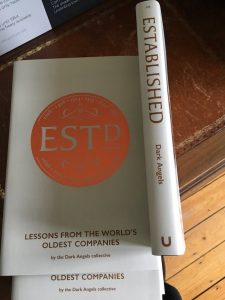
As to the concept of narrative and story. I thought hard about this in a book I co-authored recently. The book is Established; Lessons from the world’s oldest companies. My chapter, The Brush, the Mallet, the Chisel, the Letter, was a kind of history, or chronology—a narrative, if you will—about the founding and survival of the oldest operating American company, The John Stevens Shop of Newport, RI. I kept fighting the exact problem McKee lists above, ‘and then this happened, and then that happened, and then this happened, and then that…” The way I solved it, I think, was to let my utter fascination and love for the entire story come through. I lingered on the space itself, the people in the story, and the incredible skill they have and the generational aspect, three generations of men, twice over, who owned and ran this shop. But it’s probably fair to say I did not storify this piece, mainly because to do that, felt not quite right for the material I had. As my friend Nick Parker has said, ‘there’s an open question as to which sorts of content or material are ripe for a storytelling structure.” Agreed.


Blogging Storynomics 3

May 4, 2018 by Richard

This is the third post in an ongoing project to unpack Robert Mckee’s new book, Storynomics: Story-Driven Marketing in a Post Advertising World. The

In previous posts, we’ve talked about how rational based communications, are really just rhetoric, and emotional communications, have veered into manipulation of consumers, playing on fear and envy. Which is part of the reason why marketing and advertising are in such dire straits. We’ve also touched on the elements of a story– action, reaction. changing value charges, roles, conflict, turning points, emotional dynamics.

So let’s look into Chapter Three; The Evolution of Story. As you might expect from McKee, he structures some of this material in the form of a three act drama.

Excerpt:
“…a three-act adventure that begins with the birth of consciousness. It builds as the mind battles for survival, and climaxes with the triumph of storified thought.’

Consciousness is kind of the inciting incident here. The moment when everything changes and the protagonist is thrown into a whole new world, which in this case is being self-aware.


“We tell ourselves stories in order to live.” ~ Joan Didion


ACT I: THE FIRST HUMAN THOUGHT

Excerpt:
The silent awareness of “Me” suddenly transformed a brain into a mind and turned an animal human. Animals react to the objects around them, but the human brain turned itself into an object. Consciousness, in effect, split itself in two.

When self-awareness invaded the first human mind, it brought with it a sudden, sharp sense of isolation. The cost of self-consciousness is a life spent essentially alone, at a distance from all other living creatures, even your fellow human creatures. With that first, primordial I am, moment, the mind felt not only alone but also in terror. For self-awareness brought another, even more frightening discovery, unique to humanity. time. The first human being suddenly found herself alone and adrift on the river of time.

ACT II: THE SECOND HUMAN THOUGHT

“…What’s more, the mind discovered that not only is the future in doubt, but the surfaces of people and things cannot be trusted; that nothing is what it seems. What seems is the sensory veneer of what we see, what we hear, what people say, what people do. What is hides beneath what seems. For truth is not what happens, but how and why what happens happens. With neither science nor religion to explain life’s unseen causalities, the suddenly self-aware mind must have roiled in confusion as chaos, enigma, meaninglessness, and brevity made life unlivable. The mind had to find a way to make sense out of existence.

ACT III: THE STORY-MAKING MIND

Two pages in we get going…

Excerpt:
Because a well-told story wraps its telling around emotionally charged values, its meaning becomes marked in our memory.

Excerpt:
The form of story, at its simplest goes like this: As the telling opens, the central character’s life, as expressed in its core value (happiness/sadness, for example) is in relative balance. But then something happens that upsets this balance and decisively changes the core value’s charge one way or the other. He could for example, fall in love, (positive) or out of love (negative). The character then acts to restore life’s balance, and from that moment on a sequence of events, linked by cause and effect moves through time, progressively and dynamically swinging the core value back and forth from positive to negative, negative to positive. At climax, the story’s final event changes the core value’s charge absolutely and the character’s life returns to balance.


Blogging about Storynomics 2

May 1, 2018 by Richard

In our last post, we talked a little about rational communication, rhetoric, and, emotional communication, and what constitutes the current problem. No one believes marketing and/or advertising anymore. The remedy, per Robert McKee and Thomas Gerace, in Storynomics: Story-Driven Marketing in a Post-Advertising World, is story.

Excerpt from McKee:
A well-told story captures our attention, holds us in suspense, and pays off with a meaningful emotional experience. Emotional because we empathize with its characters; meaningful because the actions of our protagonist deliver insights into human nature. The word itself, story, confuses many marketers. Some, for example, use the words content and story as if they were interchangeable. As as we’ll discover, that’s like conflating paint in a can with a masterpiece on a wall.”

The other, frequent point of confusion, is between story and narrative. There are key distinctions. Hugely important differences. Of which more, later.

Here we go, this bit is where our book gets in gear and begins to really move.

McKee excerpt: In short, story is the ultimate I.T. I in that storytelling demands information–a wide and deep knowledge of human nature and its relationship with the social and physical realms. T in that a well-told story demands skillful execution of its inner technology, its mechanism of action / reaction, changing value charges, roles, conflicts, turning points, emotional dynamics, and much more. A craft underpins the art.

Storify is the word that McKee and Gerace give us to describe marketing that encompasses story structure. You got to storify it!

Here is where we begin to see some clarity around what defines a story. Story involves just what has been said above. Action, reaction. Changing value charges. Roles. Conflict. Turning points. Emotional dynamics. None of which apply to narrative.

“After nourishment, shelter and companionship, stories are the thing we need most in the world.” Philip Pullman

For me, the interesting idea running through this approach to marketing is how to apply it. Where and how can you apply a storytelling structure in your business communications? What specific pieces of content can you storify? If we’re talking about content marketing which underlies all this due to Thomas Gerace’ role at Skyword, then there are numerous avenues to work with. Customer stories, also known as case studies, are prime territory. Ads can certainly fit that bill. Corporate history can definitely be storified.

I wonder? Can you storify home page content? Can you hook a reader on the home page with a brief story, maybe as brief as six words? Ten? Stay tuned for post number three coming your way soon. Should be good, ‘The Evolution of Story’ is chapter three.


  • « Go to Previous Page
  • Page 1
  • Page 2
  • Page 3
  • Page 4
  • Interim pages omitted …
  • Page 6
  • Go to Next Page »

Primary Sidebar

Treat yourself to 5 Cool Things


5CT is a free! curatorial exuberance, a liturgy of art and literary loveliness, a dash of tech, a sparkle of Sunday wonderment from Lucid Content. Click the 5 to check it out.


George Eliot


“Blessed is the man who, having nothing to say, abstains from giving us wordy evidence of the fact.” George Eliot

  • LinkedIn
  • Medium
  • Twitter

Footer

About

Lucid Content is a small, kick-ass writing agency based on the southern tip of a magical island in the Pacific Northwest.

Connect

Address: Whidbey Island, WA
Phone: +1-(503)-621-2215
Email: richard at lucidcontent dot com

  • Dribbble
  • Facebook
  • LinkedIn
  • Pinterest
  • Twitter

Get the 5 Cool Things Blog

5CT is a free, curatorial exuberance, a liturgy of art and literary loveliness, a dash of tech, a sparkle of Sunday wonderment from Lucid Content.

Copyright © 2025 · Kreativ Pro on Genesis Framework · WordPress · Log in