• Skip to primary navigation
  • Skip to main content
  • Skip to primary sidebar
  • Skip to footer
  • (503)-621-2215
  • [email protected]
  • Instagram
  • LinkedIn

Lucid Content

  • people ask me
  • my clients
  • services
  • blog
  • Dark Angels workshops
  • get in touch

Richard

“I speak of the things that are there.”

January 23, 2020 by Richard 2 Comments

Last year my tribe published this book on writing: Dark Angels On Writing from Unbound in London. I thought I’d post the piece I wrote for the book. Just in case there are a couple of people in the world who have not yet bought the book.


What does it mean for a writer to pay attention?

“…if you love something enough and pay a passionate enough attention to it, the whole world can become present in it.”

~ John Jeremiah Sullivan

by Richard Pelletier

Here in my writing shed, under a starry night and an almost full moon, on the southern tip of this magical island in Puget Sound where I live, I imagine rummaging through a junk drawer. Amidst the rubber bands and the old paper clips, I am looking for a commemorative 1955 silver dollar that exists only in my dreams—heads on both sides. On one—the profile of the writer James Baldwin. I flip the coin. There is the curly-headed pate of my hero, the photographer Robert Frank. My America.

There was something on the wind in that year of 1955. Those two men, one black, one white, knew. Both were artists, both living in New York City. From the Village, came Baldwin with Notes of a Native Son. “The people who think of themselves as white,” he wrote, “have the choice of becoming human or irrelevant. Or, as they are indeed already, in all but actual fact, obsolete.” That same year, Frank, Swiss-born, celebrated here and in Europe, set out on a series of road trips in his 1950 Ford Business Coupe (Detroit, Savannah, Miami, New Orleans, Houston, Los Angeles) to document America in a book. The time was ripe.

The show-stopping cover of Frank’s book, The Americans, might well have flown straight out of James Baldwin’s tightly coiled rage. Five passengers sit perfectly and eternally framed in front-to-back order on a New Orleans streetcar. A white man, a white woman. A little white boy in a little white-boy suit. (Already impressive at white entitlement.) A little white girl, crying. A black man. A black woman. In a single photograph—a supremely complicated one-hundred and seventy-nine-year story. The Americans was a brutally honest chronicle. Look, it said. Open your eyes. Feel. It was the book that changed photography for all time.


Miner, shaman, brother, thief


Why is this piece of writing about writing concerning itself with the double helix that is James and Robert? My brief is to talk about writing from the perspective of being a photographer. And, it’s because good writing always concerns itself with seeing. And seeing is what James Baldwin and Robert Frank did better than almost anyone else. Each man came to it in different ways. Baldwin’s gaze was unforgiving; ethical, moral and penetrating. Loving. It was psychological, spiritual, cultural, and personal. He was sort of an apostle of humanism. Frank’s seeing was psychic surveillance. Cunning and skeptical. Exploitative. Also loving. He was a miner and a shaman, a brother and a thief. What writer wouldn’t want to be all that?

There is no evidence that Baldwin and Frank knew or influenced each other. But they were working the same dark alleys—the twisted knot of American identity. “Our dehumanization of the negro then,” wrote Baldwin, “is indivisible from our dehumanization of ourselves. The loss of our own identity is the price we pay for our annulment of his.” I pause for a quick daydream where I see Banksy, under cover of darkness, spray painting those words on the side of Robert Frank’s New Orleans streetcar.

Frank showed us something we hadn’t seen before. America as a dangerous, nervous, deeply weird, beautiful and lonely place. Everything in conflict with everything else. Not the least of which was the story we were telling ourselves about who and what we were. (This was 1955, remember.) He tunneled down much further than was comfortable. His coda to fellow artists who might be paying attention to his work (and there were legions) was: go deeper. That is the single best piece of advice a writer could ever hope to hear.

I came to Baldwin much later. Born poor, black, and bi-sexual in Harlem, he told Life Magazine:

“An artist is a sort of emotional or spiritual historian. His role is to make you realize the doom and glory of knowing who you are and what you are. He has to tell, because nobody else can tell, what it is like to be alive.”

It’s gray outside this morning—the sun is a half-lit, milky stain as it slides behind a bank of Douglas Fir outside my window. I am back at it, trying to stare down this dastardly task: to say something useful about writing and photography. So it occurs to me to talk about love. To say love is at the heart of all this. First, James Baldwin and Robert Frank both have said they loved America. Their love was complicated, but they were writing and shooting from that place. I loved—and still love—those Robert Frank pictures. They changed me from the inside out. I love them madly. I have never been the same since the moment I saw them. That body of work held me upside down and shook me until finally, I came to understand their code.

It is possible to make something beautiful and lasting and soul-shaking from the place where you—your heart and soul, your voice, your shame, your fear, your oddball ways—meet the world.

That changed everything. When you know something like that, down to the bone, all kinds of wonderful trouble is yours. Because now you believe. You believe in the premise at the root of all art making. Most worrisome of all, you now believe that you—yes, you aspiring writer, painter, poet, musician, sculptor, playwright, might wear the hat, too. To coin a phrase, you are fucked. Which is glorious.

A secret at the bottom of a frozen lake

All this inconveniently dovetailed with my beloved, fiercely believing mother’s favorite Life Lesson: ‘You can be anything you want to be, as long as you want it bad enough.’ I confess that I thought I wanted to be Robert Frank. But underneath it all chained up and locked down like Houdini, buried six feet into the bottom of a frozen lake, was my secret. I only ever wanted to be a writer. Too dangerous, so I spent years taking pictures, and I still do. But it has taken me until this moment, on this gray, overcast November morning to unlock a mystery. Robert Frank, photographer, was my first writing teacher. His courage gave me mine.

‘I worked myself into a state of grace.’ – Robert Frank

The lessons that Robert Frank has brought to my writing life are endless and ongoing. Pay attention. Go to those places—physical and emotional—that aren’t safe or comfortable and look. More important, feel. Bring your whole self. Believe what you see, but stay skeptical. Get ahold of it and report back. There are stories everywhere. An empty highway at twilight. The glowing jukebox in a dive bar. An empty café with Oral Roberts on the television. The cowboy on a Manhattan street. Gas tanks, post offices, backyards. Shift the background to the foreground. Break the rules. Do it your own way. Aim higher. And higher still. Get angry. The shadows are more interesting than the light, except for when a crushing daylight is the story. Keep your ear to the ground. Leave some work for the viewer or the reader to do. Find new ways to tell the story. When it comes time to edit, go deeper. Find the most ruthless, merciless, and intuitive version of yourself and go to work. Robert Frank took 27,000 photographs for The Americans. His book is just eighty-three pictures. It was during a year-long, deliberate editing and sequencing process, where the form and the idea and the structure became the thing that we know today. About the entire project, Robert Frank said, “I worked myself into a state of grace.”
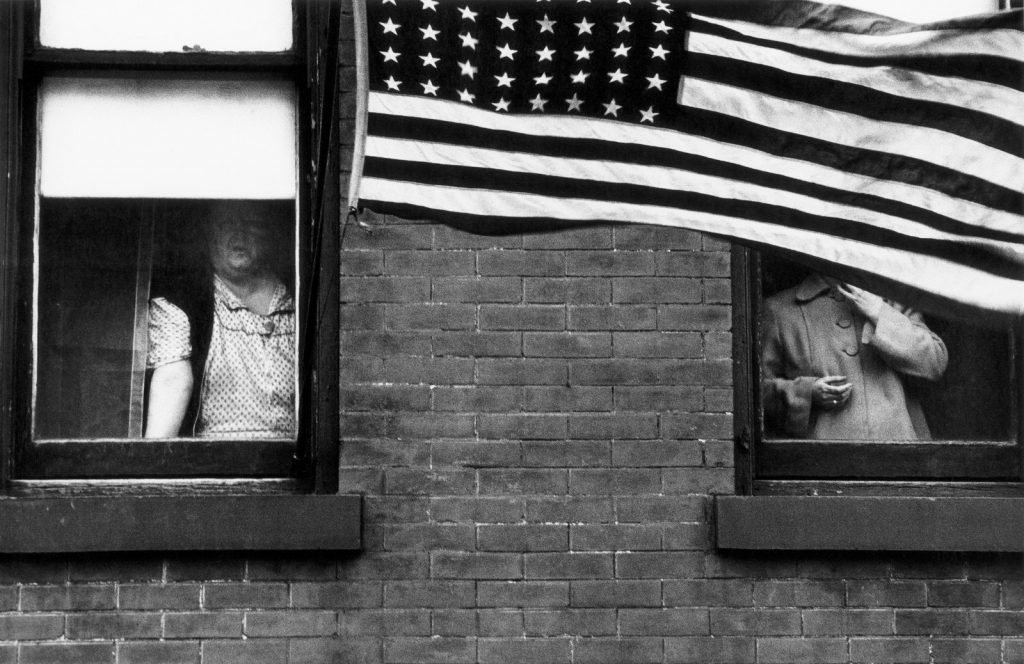
 

“Parade—Hoboken, New Jersey,” from “The Americans,” 1955.Photograph by © Robert Frank / Courtesy Pace/MacGill

“View from hotel window—Butte, Montana,” from “The Americans,” 1956.Photograph by © Robert Frank / Courtesy Pace/MacGill

“We tell ourselves stories in order to live.” – Joan Didion

I was sixteen or seventeen at the time. My grandfather lived across the street from us. I would visit on a fairly regular basis—to bring over meals my mother had cooked, or just to check in. On one particular day, I gave a soft knock on his door, and let myself in. His apartment had that old-world, grandparent charm; a lot of wood and carpeting, built-in glass and wood cabinets. Dark and quiet. He was all alone those days, my grandmother had died some years before. His TV-watching chair was empty, the television was off. But he was there all right, in the room, seated at a card table. The table was crammed—set for six people. Plates, glassware, silverware, everything you’d need if everyone came to dinner. Everyone being himself, his wife, and his four children. But he was alone. Except that he wasn’t, not quite. On each of five plates, he’d placed a framed photograph. I scanned the table. There was my father, my two uncles, my aunt, and my grandmother. Everyone had come to dinner. My grandfather was in conversation with all of them. He turned to me—an actor breaking the fourth wall—and whispered that they’d all come, finally, and wasn’t it wonderful. He turned back to the play. He was wearing two pairs of pants—he’d nap during the day, wake up confused, and get dressed again. I willingly accepted the fiction—and the truth—of all that was in front of me. I may have become a photographer that day. Or, a storyteller. Or, a human being. Joan Didion was right.

A state of grace

Nothing prepares you for writing quite like being a photographer in the days of film. You’d find yourself out in the world—say, Chinatown in New York, or on the coast of California. Endless possibilities for making pictures. Your camera is loaded with Kodak Tri-X film, thirty-six frames. You’re in a bit of a zone, the light is beautiful, and you’re working. Two weeks later, after you’ve developed your fifteen rolls from that day, you have printed your contact sheets, and you find there is nothing. Five-hundred plus images and not a single image that is more than a humble, pleasing record or a dumb cliché. You will try to convince yourself otherwise. You will lie to yourself, possibly for weeks. Maybe this frame, maybe that one. But it’s all useless, there’s nothing there. There is no better training for the excruciating experience of writing first drafts.

So something happened in the relentless effort. In the absurd amount of failure. In the commitment to trying—and the occasional succeeding—that laid the groundwork for a step into the void. My wife and I spent the first two years of our life together on opposite coasts. We spent hours and hours on the phone. She knew me as a photographer. One night I said, “I’m going to say something to you now, and I ask that you say absolutely nothing after I say it.” “Okay,” she said.
I said, “I want to write.”

The sun has returned to its milky, half-hidden ways. It’s cold outside. The wind is up. The stand of fir out past my window is telling its proud, steadfast, multi-generational tale. Later this afternoon, Linda and I will travel to the north end of the island to visit a sawmill. On that hour-long ride—through stands of fir and cedar and small towns, I’ll be thinking about a photograph I saw the other day. It’s Robert Frank, 93 years old, sitting out in front of his home in New York City. The backdrop is gritty. A green metal door, a brick section of wall, a green metal screen. The paint on the door frame is chipped and worn. And there he sits, a little hunched over. Still has his hair. He’s an old man looking straight into the camera, a father who has outlived his two children, who both died tragically. His cane is at hand. I imagine James Baldwin sitting right next to him, the other side of the coin. If he were still here, he’d be 93 too. I imagine the two of them, finally having met, after all these years of crossing paths, comparing notes. If I were there, I’d be at a loss for words. What to say to the two storytellers who saw America, who told us everything. Who spoke of the things that were there, who told us of the doom and the glory of who we are. Who left us their songs to sing.


* From Robert Frank’s Guggenheim Grant application. “I speak of the things that are there, anywhere and everywhere—easily found, not easily selected and interpreted.”


Robert Frank died on September 9, 2019. Rest in peace, Robert Frank.

Where are you going with your writing?

April 9, 2019 by Richard Leave a Comment

The Olympic Peninsula (c) Richard Pelletier

Tell me, where are you headed in your writing life? If you had wings, where would you fly to next? Are you satisfied? You ever think you could kick this thing up a notch or two? Where could you go with your writing if you could make it better by this much? Or that much? What might happen if you knew how a Shakespearean sonnet is made? What if you actually wrote one? And what if you began to fall head over heels with the whole heaving apparatus that is the English language? What would that be like?

Some of us have to write. Some of us want to write. The road that connects us is the sheer difficulty of the journey. Writing is bloody hard. But it’s not impossible to write well, or even beautifully. You just have to commit. And you have to read.

It also helps to find fellow travelers who have walked some of the trade routes and have come back with the spices and the silks, the sonnets and the similes.

So I’ve come here today to talk about the idea of writing as a deep, professional, creative, and spiritual pursuit. A beautiful, sacred undertaking that asks of you everything you’ve got and then asks for more. The pursuit of writing well gives life depth and meaning and a richness that is transcendent. It is fucking glorious to chase this mother down. There is nothing else like it. It is the hardest damn art form there is and it is better than cannabis or bourbon or chocolate. It is the closest thing to jazz.

In love there are two things — bodies and words. ~ Joyce Carol Oates

I remember seeing Joseph Campbell in an interview with Bill Moyers once. The conversation meandered and Moyers said something about people wanting to know the meaning of life. And Campbell said no, he didn’t think that’s what people were after. He thought people were after an experience of life. Meaning was not the holy grail, experience was. I remember thinking this felt exactly right.

And so I want to tell you to seek experiences. Find ways to gather with other humans in the pursuit of writing beautifully. Ask yourself this question. What could possibly be more fun, more inspiring, more, I don’t know… fuckingdelicious, than meeting a bunch of strangers — all engaged in the dogged pursuit of writing well — and spending three or four days together writing and talking and writing and talking and writing? What if you were doing all this in a beautiful place? What could that do to your writing life? Maybe change it forever? It happened to me. And it’s happened to about 300 other writers, too. Published poets, screenwriters, corporate communications people, speechwriters, content marketers, novelists, copywriters. Writers of every stripe.

I speak of the magical, the wondrous, the steeped-in-kindness-and-fellowship-and-personal-connection Dark Angels writing workshops. There is nothing like it anywhere. It is the eighth wonder of the world. Now in our 15th year, the (UK based) Dark Angels operation has flown to New Zealand and to America. If I could clamber up to the top of the world’s tallest building and shout this story out, I would do it.

Good writing isn’t a science. It’s an art, and the horizon is infinite. You can always get better. ~ David Foster Wallace

In Seattle, this June, Dark Angels will run a writing workshop aboard a 65′ yacht. The De Anza III. Our captain and speaker, is a Dark Angels alumnus, Ted Leonhardt. Ted is a brilliant and provocative thinker, and a powerful creative force. He came to a workshop, did some great work and got his wings. He is a hell of a writer and evangelist.

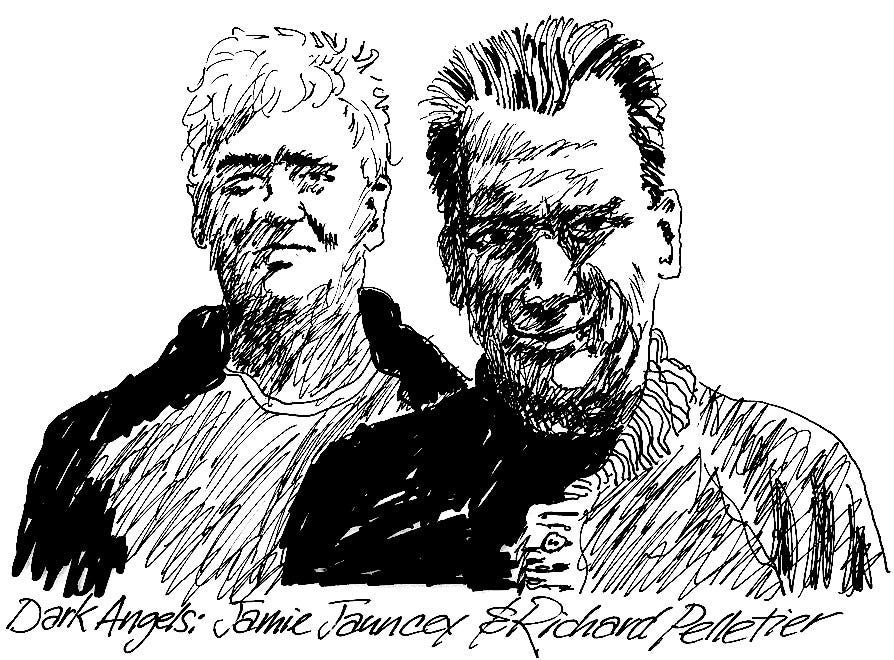
I have the distinct privilege of running this American Foundation course with a hugely talented and big-hearted writer, Jamie Jauncey. Jamie and I ran a Dark Angels America workshop last year. We want you to join us this June on the waterways of Seattle. It promises to be amazing in so many ways.

Great writers are indecent people. They live unfairly, saving the best part for paper. Good human beings save the world so that bastards like me can keep creating, become immortal. If you read this after I am dead it means I made it. ~ Charles Bukowski

I know of a great winged creature named Proust. Proust is normally found near my house, aloft on the southerly winds of Puget Sound making great big loops over Orr Road. Proust has been here forever, inspiring the artists who live on Whidbey. Lately, for reasons we suspect, but will never know for sure, Proust is often seen leaving Whidbey Island and heading out over the water to make a sweeping right turn where the mainland meets the water. Proust heads south and once she’s arrived over Ballard, Proust circles and circles and circles. We think this is because Proust knows in this place, soon, a group of storytellers will gather and she wants to be there. For you. Do not let Proust down.

~~~~~~~~~~~~~~~~~~~~~~~~~~~~~~~~~~~~~~~~

“Attending a Dark Angels course was the single best thing I did for my career, and myself, last year. As I’ve changed roles and companies, one thing was constant — writing. I’m happiest in a role with lots of writing or communicating or editing and I put a high bar on business writing that sounds human and has a personality. And sometimes in business writing, you can lose sight of that human tone among all of the requests to write about fiscal goals and org changes and new processes. So, when I heard about the Dark Angels — a group of professional writers who stand for the power of words and writing, and for personal connection, kindness and fellowship — I couldn’t register fast enough. The candid tutors put me through my paces with thoughtful exercises that taught me if there’s no tears in the writer, there’s no tears in the reader. You don’t have to be a published writer to attend; you just have to be a human who wants to write good words that make people feel your message.”

Lacy Rohre — Director, Content and Communications | EA Customer Experience

“If you want to know how to use a semicolon correctly, or learn the difference between “who” and “whom”, Dark Angels is not the course for you. These are answers found easily inside a book. Instead, Dark Angels is an experience that gently coaxes you into finding something much more important inside yourself. You’ll unearth a genuine, deeply human voice that transforms the way you write everything. I’m sneaking up on 30 years as a professional writer and I astonished myself with some of the sentences that spilled from me over the course of the four days. I feel very privileged to have become part of the chorus.”

Mat Gorbutt, Senior Writer | Fenton Stevens

“Dark Angels was a life-changer. I’ve been an uneasy writer most of my adult life — not trusting my abilities to put on paper what I had in my mind. Dark Angels reminded me about the power of honesty and empathy. Since the course, as long as I feel that I am approaching my writing with those two qualities, I feel much more confident and free of doubt. Thank you for creating a course that spoke to me so beautifully.”

Lourdes Canizares-Bidwa, Associate Director — Marketing | EY LLP


Getting a read on readability

December 11, 2018 by Richard Leave a Comment

What is readability?

In simple terms, readability refers to a tool that helps you with your writing. Some people call it a ‘readability checker.’ Officially, it’s the Flesch-Kincaid readability test. A readability checker scores your writing. (Don’t panic!) It simply looks at your writing from a couple of different angles, sentence length, difficult words, and so forth, and scores it for…readability. The scores roughly correspond to a grade level comprehension. For example, former President Obama’s speeches, generally scored at 60 or above, which corresponds to about an eighth grade reading level. It’s fairly widely accepted that a score of 60 and above is an ideal target for most business writing. It’s important to understand that this is not a dumbing down of language. You could make the argument that it’s the opposite. Simple, clear language can be incredibly difficult to achieve. 

What are the benefits?

By scoring your writing, you do two things. First, you help yourself stay on track. Second, you raise the odds that your audience will fully get what you’re saying. Let’s say you’re working on an email or a memo, or even more critically, packaging information. And it’s a complicated story and it’s important that your audience understand it all. You finish it and score it. Then you see that it scores in the 30s or 40s. That’s a snapshot of what’s going on and a strong indication you’ve got a draft that is pretty hard to understand for most people. As business writers our first job is to reach people. We have to persuade them. If our audience can’t understand what we’re saying, we’ve lost them. It’s a bit of a blunt instrument. Don’t let it rule your life. 

How do I use it?

A readability widget is embedded in Microsoft Word. In preferences, Spelling > Grammar, make sure that the ‘show readability statistics’ box is checked. From that point on, when you use the Spelling & Grammar tool, you’ll get a score. There are many free online readability checkers. 

Here are two. ProWritingAid has a free version that includes a readability score. Readability Analyzer is a free, web-based readability checker.

  1. ProWritingAid – the best grammar checker, style editor, and editing tool in one package.]

2. Readability Analyzer

This text scored a 60.9 in the Microsoft Word readability checker. In the ProWritingAid tool, it scored a 65. Huzzah! 

Me and Ellie

July 12, 2018 by Richard Leave a Comment

I fantasized about murder. Killing. I could drown her in my bathtub, which could work, but too nasty. Brutal and noisy. Wet. Too horrible to see all the way through. I thought: twist her neck. Just grab her little head and wrench with every ounce of strength I had. SNAP. Over. Abandonment seemed more merciful. Put her in the cat carrier with a blanket, a toy, some kibbles. Around midnight, carry her from my apartment over to the imposing brick manse of the Archbishop of Seattle (two blocks away) and place my sad little package on the good Father’s doorstep, as if she were the child of an illicit liaison in Catholic Ireland, too compromised by shame and sin to live among fine upstanding townsfolk. ‘You are a child of god Ellie; there will be floors to scrub, potatoes to peel, and prayers to be said, but this is your home now, lass. We will give you a bed and three squares.’ That plan seemed to hold the most promise. No bathtub scenes, no neck twisting. No killing. I might even be able to live with myself.

KITTIES FOUND ABANDONED IN BALTIMORE!

But she’d already been abandoned. We’d found her, my wife and I, with her mother or sister, we’ve never been certain about the relationship, under a marble stoop in Baltimore in March of 2007. She was this big. She and her mother were incredibly beautiful. Part Bengal, friends told us. It was cold outside. They were hungry.

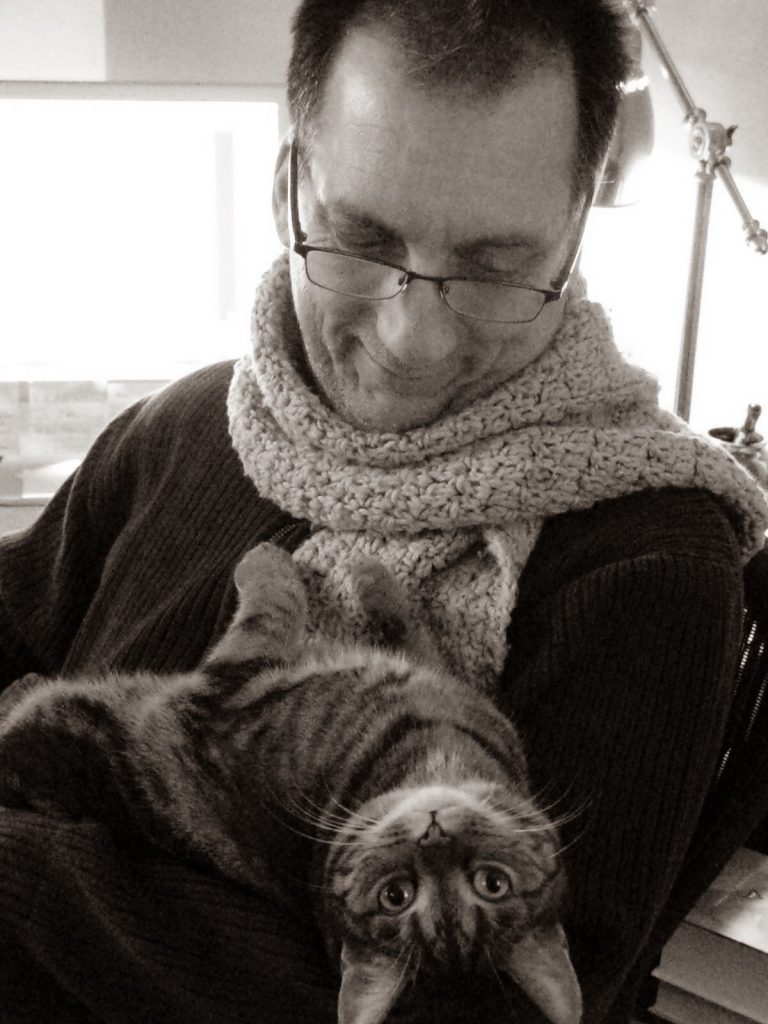
Early days they lived in our basement. We wanted to give them some time to adjust to their new world and also, to let everyone get acclimated. We had a Bichon-Frisse, Chester—the undisputed King of the Hill. On my visits to the basement, Ellie would sit on me and dangle her little feet over the edge of my arm. My wife says the look on my face when that kitten would sit on me was something she’d never seen before. We named them Ella and Billie. Cats from the streets of Baltimore, they sang for their supper, two artists of the floating world.

{Ellie on the bed, Capitol Hill, Seattle (c) Richard Pelletier}

We owned a big, three-story house back then with two staircases, one front and one back. Which meant Ella and Billie would race up the front stairs all the way to the third floor, climb our drapes all the way to the ceiling, (nine feet high) shimmy back down and then race down to the first floor via the back stairs. Every once in a while, Ellie would try to sit on the top edge of a hanging picture frame. CRASH!

They hunted rats out in the backyard, they slept, they ate, they shit. They were mad about watching water drain out of the tub. Moving water was like some kind of apparition for both of them. D’you see that?? The fuck is that?? Billie was sphinx-like, she could sit in one position for hours at a time. Ellie was restless; she lived for the edge. I was out in our backyard in Baltimore one day when I heard her crying. I couldn’t see her anywhere and kept trying to place the sound. Then I saw. She had climbed the fire escape of a shit, mostly abandoned apartment building two doors over. Nine apartments, eight of them empty, all in various states of urban horror. She was in the window, up on the third floor unable to get out. Screaming her head off. When I got to her, (no small feat) she was racing around the room in circles in a full-blown panic. The carpet was covered — and I do mean covered, as in several inches thick — with broken glass and hypodermic needles. I managed to snag her and get her into the cat carrier and got her safely home. The next adventure was in the other direction and involved fire escapes and extremely large dogs. It wasn’t long after that she got a uterine infection, nearly died, spent a week on IV at the vet, where they put a leather mask on her head, because she was an absolute terror to deal with as a patient. (Linda’s theory is that this vet visit was so traumatic, it changed her for life. Probably true.) She began to stay closer to home, where Chester would hump her every chance he got.

THE KING OF THE HILL SUCCUMBS, HIPSTERS IN PORTLAND

A few years later, we moved across the country to Portland, OR. We put the girls in cat carriers and drove them to the airport. We told them we’d see them soon, sent up a prayer and crossed our fingers. They were bound for Kitty Kat Kondos in Portland. We were headed to Maine, other parts of New England, a bit of Canada, then all the way across the country to Portland. In Maine, our dear little Chester — an old man by now — succumbed to his advancing years and died in Linda’s arms. ‘Guys, I am not moving to fucking Portland.’ Before he went, she carried him along a river bank in the New England afternoon light so he might catch one last breeze. In our house right now, somewhere, is a little wooden box with a little metal plaque on it. Chester.

This was early fall, 2008. In the time of Obama. In the time of the oil boom in the Dakotas. In the time of blue flames and westerns skies lit by oil wells. As we crossed the Dakotas in the middle of the night, we played Native American radio, and the two of us banged on the doors and the dashboard in delirious unison with Indian drummers. Under the stars we barreled west toward our new home and our girls.

The day that Linda brought them home, a month after we’d dropped them at the airport in Baltimore, they climbed out of their carriers, sniffed around for a while, checked out the rooms. Okay, this is good. I see my old pillow over there. How long before we get to go outside again? When’s dinner? Where is Chester? 

{Ellie, helping out in the office in Portland (c) Richard Pelletier}

Portland was uneventful, placid even. Naps and hanging out and neighborhood explorations. No abandoned tenements, no rats. It was Portland. Nothing happens in Portland except for beer and pot, food and bands. Ellie would wander, and Linda would walk the neighborhood calling her name, “Ellie bell! Ellie bellie!” and finally she’d prance into view and let herself be carried home. One morning saw a standoff between Ellie and a family of raccoons, but the situation resolved itself peacefully.

{Ellie and me, nap time, Portland (c) Richard Pelletier}

In 2012, Linda and I separated. I went to Seattle for a job, Linda stayed in Portland. I would take the cats. And one fine day, after I got settled, Linda drove the three hours to my apartment with the girls in the back seat, yelling all the way. By the time she got to my place, Billie was foaming at the mouth, and if memory serves, she’d shit herself along the way.

Ellie lost her mind. Her new home was a studio apartment. I went to work every day, a 45-minute drive to hell and back (I wrote copy for a company that made child safety seats for cars) during which I’d alternate between weeping and listening to NPR. And then I lost my job, and I was home. Me, Billie and Ellie. We were all miserable. Ellie yowled. And yowled and yowled. And yowled. The sounds she made broke bone. She made EXTREMELY LOUD sounds I’d never heard before. She couldn’t go outside, and there was no Linda, her entire world had disappeared. She’d start at 4 am, and she could go — on and off — until 11 am — seven hours later —when she’d collapse in exhaustion. I terrorized her to shut her up. I’d apologize. I’d walk the streets to get away from her. I spent untold hours in cafes. At night she climbed up onto the bed to sleep right near my head, like always. If she didn’t reach her little paw out to touch me, I’d reach my paw out to touch her. It was a crazy kind of love. The only way out of the pain is to go through it, I’d tell her. We prayed for better days.

{Ellie, trying to figure out where it all went wrong. Capitol Hill Seattle (c) Richard Pelletier}

I spent my days and nights trying to figure out where everything had gone wrong.  At one point, I discovered that if I didn’t move, and tried to stay out of sight, Ellie would calm down. Don’t move. (I’d have been wise to discover this trick a lot earlier for the sake of my marriage.) Then I found The Good Wife on Netflix. So there I was, in the middle of the day, recently fired, separated from my wife and friends, frozen to my couch, (don’t fucking move!) binge-watching Peter Florick and Alicia Florick negotiate Peter’s lying, infidelity, cravenness, job loss. All of which bore discomfiting similarities (minus prison, politics, prostitutes) to my own circumstances. I found a therapist who listened to all my sad stories. “Richard,” she said, “life is yes and no. You’re missing the ‘no’ part.”

When I heard about those other scandals, the other wives… I thought… how can you allow yourself to be used like that? And then it happened, and I was… unprepared. ~ Alicia Florrick

You have to control the narrative. ~ Peter Florrick

I tried to write; I tried to work. But with Ellie, nothing was possible except minimal survival. Either from exhaustion or luck, she slept at night but woke around four or five in the morning, and her bone breaking howls would begin again. So I fantasized about taking her out. Literally. This went on for a year. And then another year.

Linda and I reconciled in 2013. Over the course of the next two-plus years, we tried to live with Ellie who had seriously gone bonkers. For a while, my workaround for her 4 AM meltdown was a pair of foam earplugs. On top of which I placed a pair of old-school type headphones plugged into my iPhone which was tuned to chanting. So as Ellie began her bone shattering songs, jumping on and off me in the dawn, I was swept away to a stone chapel filled with bald headed monks singing. I experienced the deepest sleeps of my life in those mornings. I was in heaven.

Then we drugged her.

URBAN KITTIES IN THE WILDS

Soon after we drugged her (miraculous transformation btw), we moved to Whidbey Island, just north of Seattle. Ellie was free again. And then she brought us mice and moles and snakes…and one day, a hummingbird. (‘Those you don’t hunt Ellie.’) She was in heaven.


{Ellie’s new home, Whidbey Island, WA (c) Richard Pelletier}

She traveled to the outer edges of our quite rural property which is three plus acres, it’s big. All went surprisingly well. Over the last year or so, we’d worked out a routine, and it ran like clockwork. We kept her in at night because we have coyotes and owls and eagles and they eat kitties. But a  couple of times the routine broke — she didn’t come home at night. Linda and I would stay half-awake the whole night, listening, waiting, miserable with worry. As morning broke, she’d prance in to our bedroom, chatting away, looking for breakfast.

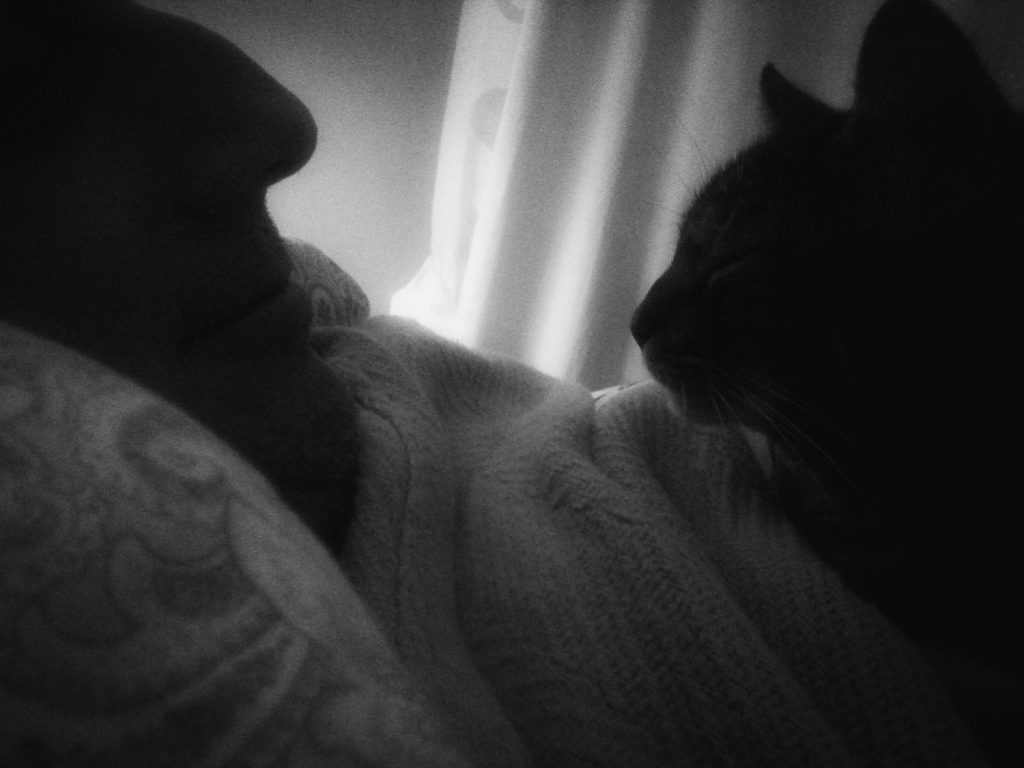
At night in bed, as we read, Ellie would sit by Linda’s pillow. Her nose was aimed at Linda’s cheek. Same position every night.

Then one night it happened again. She didn’t come home. And we thought, ‘ah, she came home last time, probably all good.’ But this time, Ellie did not come home. A day passed. And then another. And then another. And now, more days than I can count have passed, and she has not come home. The space between our pillows is quiet, empty. We don’t hear her breathing, we can’t hear the little whistle of air singing through that little nose, telling us we are all here now, the three of us, and we are sleeping.

I wouldn’t a done it, Ellie. Couldn’t a. Never.


{Ellie ~ 2006 – 2018 (c) Richard Pelletier}

Blogging Storynomics 9 | Three-act structure and the business of storytelling

June 13, 2018 by Richard Leave a Comment

Wheat Field with Cypresses, Vincent Van Gogh
THREE-ACT STRUCTURE

One of the more curious bits about the intense interest in storytelling for business, is that the two most learned writers in the realm of dramatic storytelling, Robert McKee in America, and John Yorke in England, are taking on business storytelling. Both have quite a lot to offer. Both have deep expertise and experience in the real world of drama, including television and cinema. I took a Story for Business course with John Yorke, which I have to say, was seriously eye-opening. It changed a lot for me. I would not be writing these posts, reading these books or thinking about my business the way that I am, were if not for John Yorke and Nick Parker, who helped design John Yorke’s program. That program lives at The Professional Writing Academy in the UK. They do a terrific job. I highly recommend it.

Onto today’s business — three-act structure in which I’m pulling from John Yorke’s book, Into the Woods.

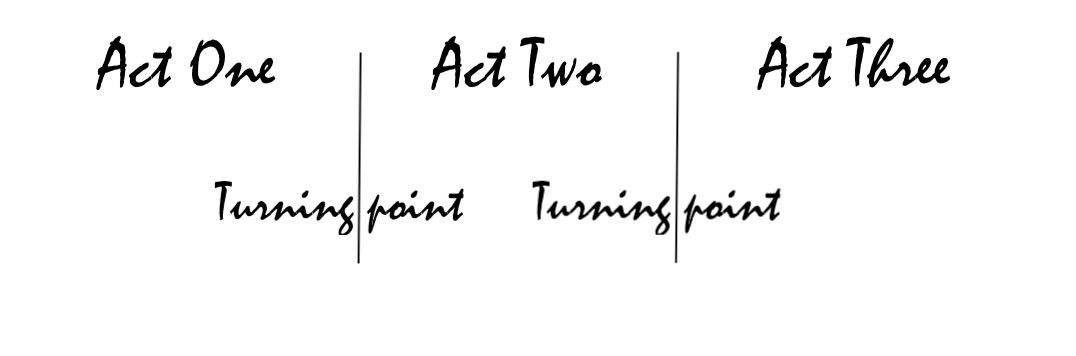
Excerpt from John Yorke: Three-act structure is the cornerstone of drama primarily because it embodies not just the simplest units of Aristotelian (and indeed all) structure; it follows the irrefutable laws of physics. Everything must have a beginning, a middle and an end. Screenwriting teacher Syd Field first articulated the three-act paradigm breaking act structure down to these constituent parts: set-up, confrontation and resolution, with a turning point toward the end of the first (the inciting incident) and second (the crisis) acts.

CORPORATE STORYTELLING

I want to be careful about diving too deep into drama and in screenwriting. My aim here is to use McKee and Yorke to help us figure out storytelling for business. I want to make sure we’re tacking close to the wind. The reasons that this kind of story structure makes sense for us as business writers are several. This approach helps us to ask better questions. What happened? Who’s story is this? Who or what got in the way? How did the protagonist surmount the obstacles? What are the stakes? This way of working points the way to creating something that is compelling. And there’s an underpinning, a framework to build the story on. So I’m going to offer up another story from the Lucid Content archives.


“There is no greater agony than bearing an untold story inside you.” –Maya Angelou


A client of mine is a gardening / nursery company in Eugene, Oregon. The patriarch of the family (let’s call him Frank) founded, owned, and ran the business for years. Their mainstay product are DIY greenhouses. Here’s an abbreviated version of their story.

Frank takes his family on a short vacation. He leaves a small, translucent box, (a fruit tote) upside down on his lawn. On his return, the grass beneath the tote, is thick, rich, dark green. Trapped, warm air created a greenhouse effect. He learns what the plastic is, orders sheets of it, then goes into his home workshop and in short order, builds a sort of backyard, do-it- yourself greenhouse. Presto! Successful family business. Over the years, thousands of units sold and shipped across the country. The business takes over family life, even the the family home. Teenage daughter HATES this business and everything about it. All is going well until… A supplier of the plastic, the very material that the greenhouses are made of, ships defective material. (We have our antagonist.) Many customers are impacted. The business owners by now are older, they’re tired. Everything they have built, including their integrity, their relationship with employees (unusually stellar) is in jeopardy. There’s a lot at stake. They consider shutting down. But wait! But the once recalcitrant daughter is a grown woman. And, surprise, she is a Master Gardener with an MBA in Business. She BUYS THE COMPANY. Her first efforts fail, the crummy manufacturer won’t help her identify which lots were bad, making it almost impossible to find affected customers. She can’t produce the greenhouse kits until she has a better supplier. In the interim, she ships a comparable – competitor product so her customers can get their needs filled. Finally, she finds a new manufacturer, doubles the 10-year warranty to 20, and in the process, finds a way to make whole those customers who had received bad product, and, ushers her parents gently into retirement and shifts her greenhouse kit marketing campaign to…cannabis.

Act I: formation of the company.
Turning point or inciting incident: Manufacturer ships defective materials, company survival at stake.
Act II: Daughter buys the company
Crisis point in Act II: Daughter cannot identify all the customers who got bad product, reputation at stake…ships competitor product…
Act III: Daughter finds new manufacturer, doubles warranty, finds affected customers, makes them whole, parents retire…

Whether we want to structure our stories along certain well-traveled paths or not, it’s often the case that stories organically conform to certain types of structure. Even David Mamet says so.

Excerpt from John Yorke: In simple terms, human beings order the world dialectically. Incapable of perceiving randomness, we insist on imposing order on new phenomena, any new information that comes our way. It’s thesis, antithesis, synthesis. As David Mamet says: ‘Dramatic structure is not arbitrary — or even a conscious invention. It is an organic codification of the human mechanism for ordering information. Event, elaboration, denouement; thesis, antithesis, synthesis; boy meets girl, boy loses girl, boy gets girl; act one, act two, act three.”


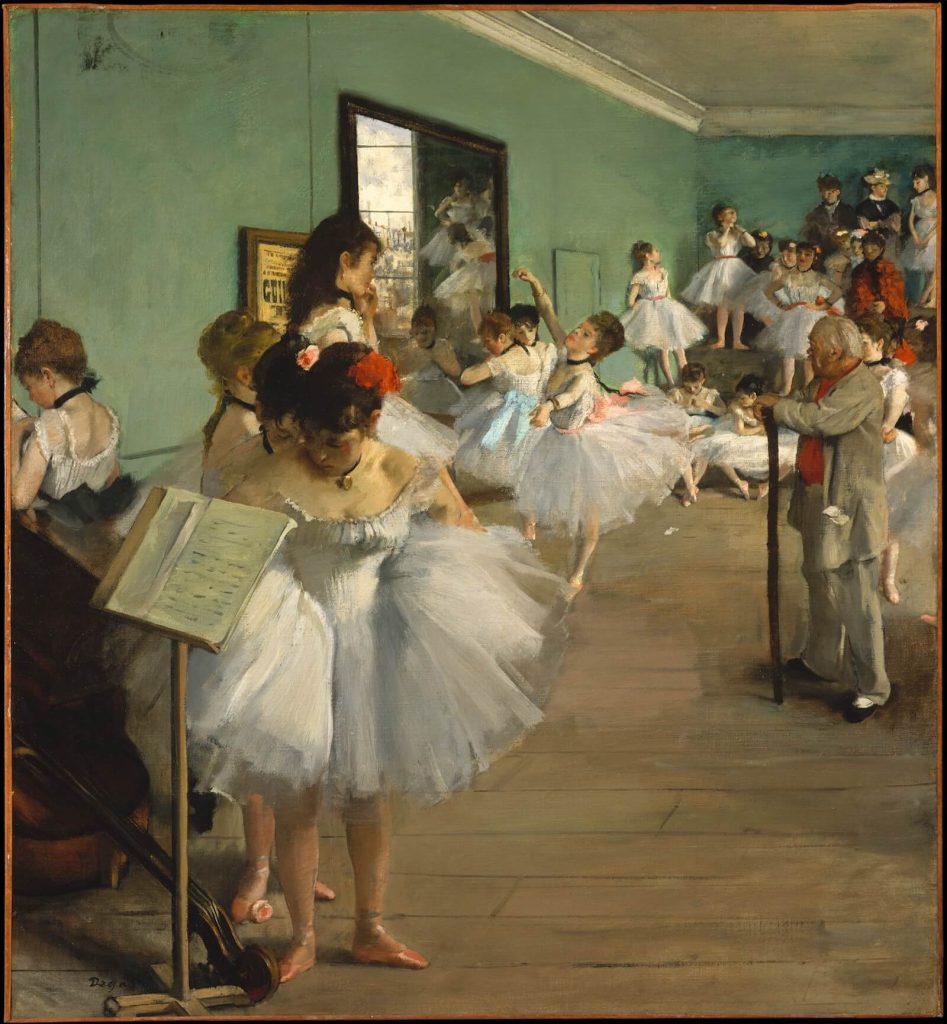
Image credit: The Dance Class, Edgar Degas 1874

Blogging Storynomics 8

June 10, 2018 by Richard Leave a Comment

So we’ve been blogging our way through Robert Mckee’s Storynomics: Story-Driven Marketing in a Post-Advertising World. We covered rational and emotional communications in the first post…we talked about the importance of story, the notion that story is the remedy for what ails business communications…we hinted at the difference between narrative and story and then we truly unpacked the narrative – story definitions.


“All great literature is one of two stories; a man goes on a journey or a stranger comes to town.”
― Leo Tolstoy


We talked about human consciousness and how story-making emerged to help humans make sense of everything around them. We touched on the eight stages of story design (rather intricate engineering from the Mind of McKee.) We looked to John Yorke’s book on storytelling, Into the Woods. We got into binary values in storytelling: truth/lies, good/evil, love/hate, success/failure. Time and space showed up in blog post six. And in the last post, number seven, we talked about the inciting incident — the event that launches the story.

This next bit that is coming soon from John Yorke, is quite interesting too. I speak of the Three-Act Structure. But for now, just plain old structure…

Excerpt from John Yorke’s book: I smacked my little boy. My anger was powerful. Like justice. Then I discovered no feeling in the hand. I said, ‘Listen, I want to explain the complexities to you.’ I spoke with seriousness and care, particularly of fathers. He asked, when I finished, if I wanted him to forgive me. I said yes. He said no. Like trumps.

Yorke continues -> ‘The Hand is a chapter in a short story, ‘Eating Out,’ by the American miniaturist Leonard Michaels; it’s also in effect a complete story in itself. If all stories contain the same structural elements, then it should be relatively easy to identify within ‘The Hand’ the building blocks with we should now be familiar.

Protagonist — the narrator
Antagonist — his son
Inciting incident — awareness of no feeling in hand
Desire — to explain his action
Crisis — ‘He asked…if I wanted him to forgive me’
Climax — ‘I said yes. He said no’
Resolution — ‘Like trumps.’

So I’d like to jump in here and bring this back to a business story situation. In an earlier blog post, I talked about an inciting incident that involved Boeing 787 aircraft. What happened was that a couple of years after launch, a number of these new aircraft experienced problems…lithium-ion batteries had overheated. The entire fleet — worldwide — was grounded by the FAA. That is an inciting incident for the ages. Here’s the opening to the case study I wrote for Base2 Solutions a few years ago.


The Right Teams Get the 787 Flying Again
Base2 Joins Experts to Help Solve Boeing Battery Issue

Boeing faced a huge operational and public relations debacle. The FAA had grounded the 787 Dreamliner. Incidents involving lithium-ion batteries took place on two separate aircraft. Engineers from Base2 joined teams of experts working to find and resolve the problem.   

When 15,000 people watched the rollout of Boeing’s 787 Dreamliner on July 8, 2007, expectations ran high. The plane was more fuel-efficient than other planes its size. Composite materials made up 50 percent of the primary structure of the plane. And, it relied more on electrically generated hydraulic power for primary flight controls. The first plane shipped in September of 2011.

Then in early January 2013, the FAA grounded the fleet. Two lithium-ion batteries, used for back up power for flight controls, had overheated or vented. The FAA ordered a thorough review by technical investigators.

###


Business stories — and especially case studies — can easily be structured around a time-honored storytelling structure. In this story, is the protagonist the new, but flawed (isn’t the hero always flawed?) 787 Dreamliner? Or is it The Boeing Company? It’s The Boeing Company—whose world has been suddenly turned upside down. It’s The Boeing Company who will have to face down the antagonist or forces of antagonism: the FAA and the problem batteries.

So we already have the beginning ingredients we need for a story. But it gets better. We also have values that arrive in the form of a positive / negative charge. (Ha!) There is success/failure, competence/incompetence, safety/danger and, profit/loss. Right? And by the way there is time and place. The meaning of this story is defined by the period of time that the story describes. Place is simple: the fleet of 787s.

One last point. I loathe the tiresome case study structure of problem – solution – outcome. Just seeing that makes me want to gouge my eyes out. However, that underlying idea that a) something strange or weird or bad happened and b) he/she/they/someone had to work to get things back into balance, and c) balance restored, planes flying again, FAA satisfied, profits and safety secured…it kind of does have a problem, solution, outcome framework underneath it all…

It’s very much a three-act structure, which we’ll dig into more in the next post.

Thanks for reading. 🙂

Photo credit: Icarus, Empire State Building 1930 Lewis Hine photographer

  • Page 1
  • Page 2
  • Page 3
  • Interim pages omitted …
  • Page 6
  • Go to Next Page »

Primary Sidebar

Treat yourself to 5 Cool Things


5CT is a free! curatorial exuberance, a liturgy of art and literary loveliness, a dash of tech, a sparkle of Sunday wonderment from Lucid Content. Click the 5 to check it out.


George Eliot


“Blessed is the man who, having nothing to say, abstains from giving us wordy evidence of the fact.” George Eliot

  • LinkedIn
  • Medium
  • Twitter

Footer

About

Lucid Content is a small, kick-ass writing agency based on the southern tip of a magical island in the Pacific Northwest.

Connect

Address: Whidbey Island, WA
Phone: +1-(503)-621-2215
Email: richard at lucidcontent dot com

  • Dribbble
  • Facebook
  • LinkedIn
  • Pinterest
  • Twitter

Get the 5 Cool Things Blog

5CT is a free, curatorial exuberance, a liturgy of art and literary loveliness, a dash of tech, a sparkle of Sunday wonderment from Lucid Content.

Copyright © 2025 · Kreativ Pro on Genesis Framework · WordPress · Log in